Structured Diets, Rapid Modernization, and Rising Metabolic Disease
A region of strong traditional food systems
East Asia developed some of the world’s most structured and historically stable dietary patterns.
Across China, Japan, and Korea, traditional diets emphasized:
- rice or grain-based meals
- vegetables and legumes
- soy-based foods
- fish and modest animal protein
- fermented foods in many settings
- structured, meal-based eating
These diets were generally lower in added sugar and lower in ultra-processed food exposure than the modern industrial diet. They supported metabolic stability for generations.
Then vs Now
Traditional Pattern
Rice- or grain-based meals
Vegetables and legumes
Soy foods and fermented foods
Structured eating
Lower sugar exposure
Modern Pattern
Sugary beverages
Ultra-processed foods
Refined convenience meals
Packaged snacks
More frequent eating
This transition has not occurred at the same speed in every country, but it is now visible across the region.
A regional pattern with national variation
East Asia is not a single dietary story.
China
A vast and heterogeneous food system undergoing one of the largest nutrition transitions in modern history, with rising concern over sugar-sweetened beverages, metabolic syndrome, fatty liver disease, and liver-related outcomes.
Japan
A country with one of the strongest traditional meal structures and one of the most developed public-health responses to metabolic syndrome, including national screening and prevention efforts focused on abdominal adiposity and cardiometabolic risk.
Korea
A rapidly modernizing dietary environment with rising intake of ultra-processed foods, increasing metabolic syndrome, and strong national research tracking the health effects of changing diet and lifestyle patterns.
Despite these differences, the underlying transition is shared.
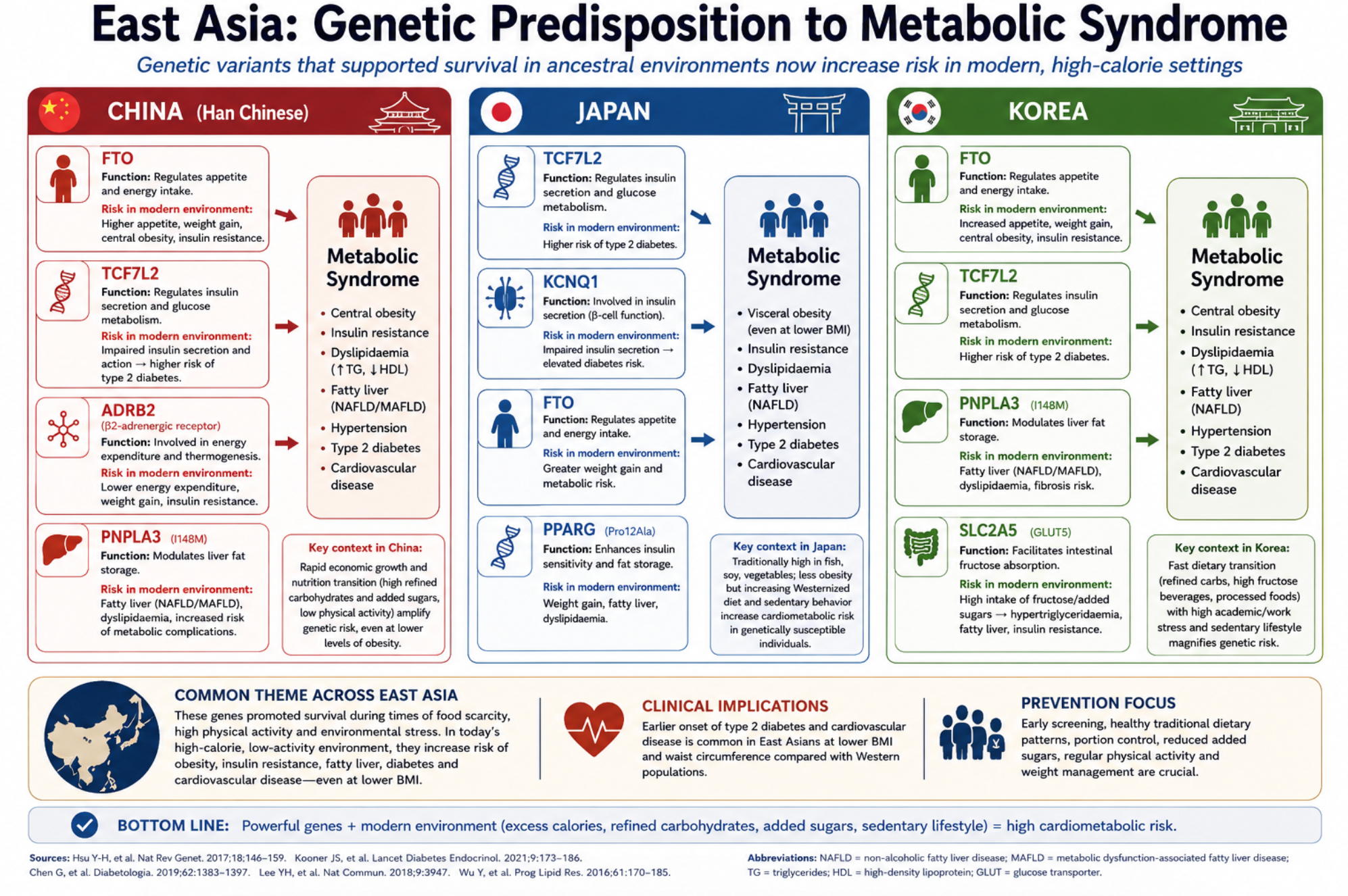
From structured meals to continuous exposure
One of the defining shifts in East Asia is not only what people eat, but how they eat.
Traditional diets were:
- meal-based
- structured
- repetitive in a stabilizing way
- low in liquid sugar exposure
Modern food environments increasingly favor:
- snack-based intake
- packaged foods
- sugar-sweetened beverages
- convenience-store eating
- refined, rapidly absorbed foods
This shift increases both the amount and frequency of metabolic exposure.
Sugary beverages and the new sugar environment
Sugar-sweetened beverages have become a major marker of dietary change across East Asia.
They are especially important because they deliver:
- rapid sugar absorption
- weak satiety
- frequent intake between meals
China has seen active public-health and policy debate around sugar-sweetened beverage exposure in children and adolescents. Korea’s dietary transition increasingly includes processed foods and beverage exposure within a broader ultra-processed environment. Japan has not reached the same level of beverage-driven exposure as some countries, but the pressure from sweetened convenience foods and beverages is still part of the changing food environment.
Metabolic syndrome as a central research theme
East Asia has become one of the most important regions in the world for metabolic syndrome research.
This is partly because the region demonstrates something clinically important:
👉 serious metabolic disease can develop at lower BMI than in many Western populations
Researchers across China, Japan, and Korea have focused heavily on:
- visceral adiposity
- insulin resistance
- dyslipidemia
- fatty liver disease
- cardiometabolic risk at relatively modest body weight
Japan in particular has formalized metabolic syndrome screening in national health policy, while Korea and China continue to produce large-scale epidemiologic research on diet, body composition, and metabolic disease.
Liver fat, cardiovascular disease, and cancer links
East Asia also shows how metabolic disease extends beyond glucose and weight.
The regional pattern increasingly includes:
- fatty liver disease
- cardiovascular risk
- overlap between metabolic dysfunction and liver-related outcomes
- growing concern about links between poor diet, metabolic syndrome, and cancer risk
China has emerging projections showing continuing burden from metabolic dysfunction–associated liver disease and liver cancer. Korean and Japanese research increasingly connects diet quality and metabolic risk to both cardiovascular and mortality outcomes, and broader East Asian work has highlighted gastrointestinal cancer risks in food environments characterized by lower fiber and greater processed and sugar-rich intake.
A region of early recognition
East Asia is especially important because it has not only experienced metabolic transition — it has often recognized and studied it earlier than many other regions.
This gives the region a dual role:
- as a warning
- and as a source of epidemiologic and clinical insight
Japan’s policy response, Korea’s lifestyle and ultra-processed food research, and China’s large-scale work on metabolic syndrome and liver disease all make East Asia central to understanding the modern metabolic crisis.
Why East Asia matters
East Asia matters because it shows that metabolic disease does not require a fully Western body habitus or a historically Western diet.
It demonstrates that when traditional structured food systems are replaced by:
- refined foods
- sugary beverages
- ultra-processed products
- more frequent intake
the same metabolic pathway emerges:
- liver fat
- insulin resistance
- dyslipidemia
- metabolic syndrome
- cardiovascular disease
The pace and severity vary, but the biology is consistent.
Intervention opportunity
East Asia retains important strengths:
- strong traditional food patterns
- widespread familiarity with vegetable- and legume-rich meals
- cultural memory of structured eating
- substantial research and public-health infrastructure
The most promising strategies include:
- preserving meal structure
- reducing sugary beverage intake
- limiting ultra-processed foods
- reinforcing traditional dietary patterns that are high in vegetables, legumes, fish, and minimally processed staples
These are not nostalgic ideas. They are practical ways of reducing metabolic load.
Bottom line
East Asia provides one of the clearest examples of how quickly metabolic disease can emerge when highly structured traditional diets are exposed to modern processed food systems.
The region now sits at the center of global research on:
- metabolic syndrome
- visceral adiposity
- fatty liver
- cardiovascular risk
- the long-term consequences of food transition
It is both a region in transition and a region that helps explain the transition itself.
Explore Full Atlas of the Global Metabolic Crisis
Main Global Crisis Page • How the Metabolic Crisis Developed • Rising Chronic Disease
Regions:
Africa • Europe • Middle East and North Africa • South Asia • East Asia • Southeast Asia • Oceania and Pacific Islands • Latin America and Caribbean • North America