A country of two food systems, and many regional food memories.
Mexico is geographically part of North America, but culturally and nutritionally it also belongs deeply to Latin America and Mesoamerica. That internal contrast is why Mexico is so important to the global metabolic crisis: old food systems and modern industrial food systems now live side by side.
Mexico is not one diet
The older page was right to emphasize this: Mexico is often described as a single dietary culture, but it contains distinct regional food systems shaped by geography, agriculture, history, migration, and economic integration. A northern border city, a central highland town, a southern Indigenous community, a Pacific fishing village, and a Mexico City neighborhood do not have the same food history.
At a broad level, northern and border regions have stronger ranching, wheat-flour, meat, dairy, and United States food-system influence. Central Mexico carries the deep milpa pattern of maize, beans, squash, chile, vegetables, herbs, and market foods. Southern and Indigenous regions preserve more older maize-based, bean-based, squash-based, chile-based, fruit, cacao, root, herb, and local-crop traditions. Coastal regions add fish and seafood. Urban Mexico adds another layer: convenience stores, packaged snacks, fast meals, sugar drinks, long commutes, and less daily movement.
North and border regions
More ranching culture, meat, wheat tortillas, flour products, dairy, cross-border retail, packaged foods, and U.S.-style fast-food exposure.
Central highlands
Milpa foods, corn tortillas, beans, squash, chile, nopales, market vegetables, soups, stews, eggs, and structured home meals.
South and Indigenous foodways
Older maize, beans, squash, chile, cacao, herbs, local fruit, roots, regional vegetables, and community food knowledge remain central.
Coastal and urban Mexico
Fish, seafood, fruit, rice, and regional cooking persist, while urban life adds sweet drinks, convenience stores, processed snacks, and fast meals.
The milpa is not the metabolic problem
Traditional Mexican diets were built around maize, beans, squash, chile peppers, vegetables, fruits, herbs, and local foods. These foods formed a classic milpa system: a food ecology, not simply a list of ingredients. Maize and beans together supplied energy, fiber, minerals, and protein balance. Squash, chile, herbs, and vegetables added micronutrients, flavor, and plant diversity.
A handmade corn tortilla eaten with beans, vegetables, chile, squash, avocado, eggs, fish, or meat is metabolically different from a day built around soda, sweetened juices, packaged snacks, refined flour, and constant grazing. The public health message should not be “Mexican food is unhealthy.” The better message is: protect the older structure from the industrial layer that has been added around it.
What changed
Mexico’s modern dietary transition includes more than one change at once: refined carbohydrates, liquid sugar, processed snacks, sweetened breakfast foods, fast meals, larger portions, more eating outside the home, and less physical labor. These changes are not evenly distributed. They affect urban and rural communities differently, and they often arrive through price, advertising, convenience, school environments, work schedules, and retail distribution.
The North American food economy matters here. Trade, border commerce, supermarket expansion, convenience stores, beverage distribution, and migration all changed what became normal. Mexico therefore belongs in both stories: the Latin American food transition and the North American industrial food system.
Traditional strengths
Maize, beans, squash, chile, tomatoes, nopales, avocado, local fruits, herbs, seafood, soups, stews, and home-prepared meals.
Modern pressures
Soft drinks, sweetened juices, packaged snacks, refined flour, fried convenience foods, large portions, long workdays, and less daily movement.
Disease pattern
Mexico has seen rising Type 2 diabetes, obesity, metabolic syndrome, fatty liver disease, cardiovascular disease, and gout risk.
Why sugary drinks matter so much
Sugary drinks are a central part of Mexico’s modern metabolic story because liquid sugar is easy to consume quickly, often does not create the same fullness as food, and delivers fructose directly to the liver. Common patterns include soft drinks, sweetened fruit beverages, flavored drinks, packaged juices, and sweetened drinks consumed with meals or between meals.
Frequent liquid sugar exposure can contribute to insulin resistance, hepatic fat accumulation, high triglycerides, high uric acid, and dyslipidemia. This is why Mexico’s public health response has received international attention: sugary-drink taxes, front-of-package warning labels, school-food rules, and public awareness campaigns all recognize that the food environment matters, not just individual willpower.
Why Mexico matters
Mexico matters because it shows the global metabolic crisis in a vivid and culturally specific way. It has one of the world’s great traditional food systems, but it also has intense exposure to the modern sugar-and-processed-food economy. It shows how chronic disease can rise when older food structures are not simply abandoned, but surrounded.
The hopeful part is that the answer is not foreign to Mexico. It is already present in Mexican food history: maize with beans, vegetables with chile, soups and stews, market foods, regional cooking, water instead of sweet drinks, and meals that make sense inside family and community life.
Related book: Spanish edition
The Spanish edition of The Sweet Killer is a natural companion for readers who want the broader story: fructose, genes, fatty liver, insulin resistance, diabetes, uric acid, and the global spread of processed food.
Projection of the Problem
By 2050, Mexico will share with the Middle East the worst metabolic disease in children and young adults in the world.
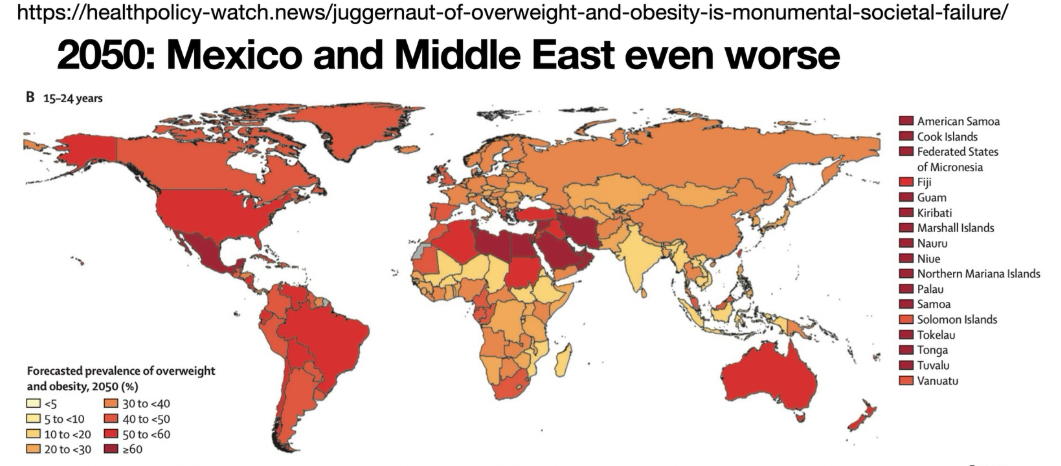
Why Mexico Matters
Mexico illustrates how quickly metabolic disease can expand when:
- Traditional diets are displaced
- Sugary beverages become dominant
It is one of the clearest modern examples of dietary-driven disease.
Explore Full Atlas of the Global Metabolic Crisis
Main Global Crisis Page • How the Metabolic Crisis Developed • Rising Chronic Disease
Regions:
Africa • Europe • Middle East and North Africa • South Asia • East Asia • Southeast Asia • Oceania and Pacific Islands • Latin America and Caribbean • North America