Introduction
Metabolic dysfunction–associated steatotic liver disease (MASLD) is now one of the most common liver conditions worldwide. In many individuals the disease remains relatively stable, but a subset of patients may develop progressive liver fibrosis.
Fibrosis refers to the accumulation of scar tissue within the liver. Over time, advanced fibrosis can lead to cirrhosis and impaired liver function.
Because liver biopsy is invasive and not suitable for routine screening, clinicians increasingly rely on non-invasive scoring systems to estimate fibrosis risk. One of the most widely used tools is the FIB-4 index, which uses routine laboratory values to help identify patients who may require further evaluation.
What Is the FIB-4 Index?
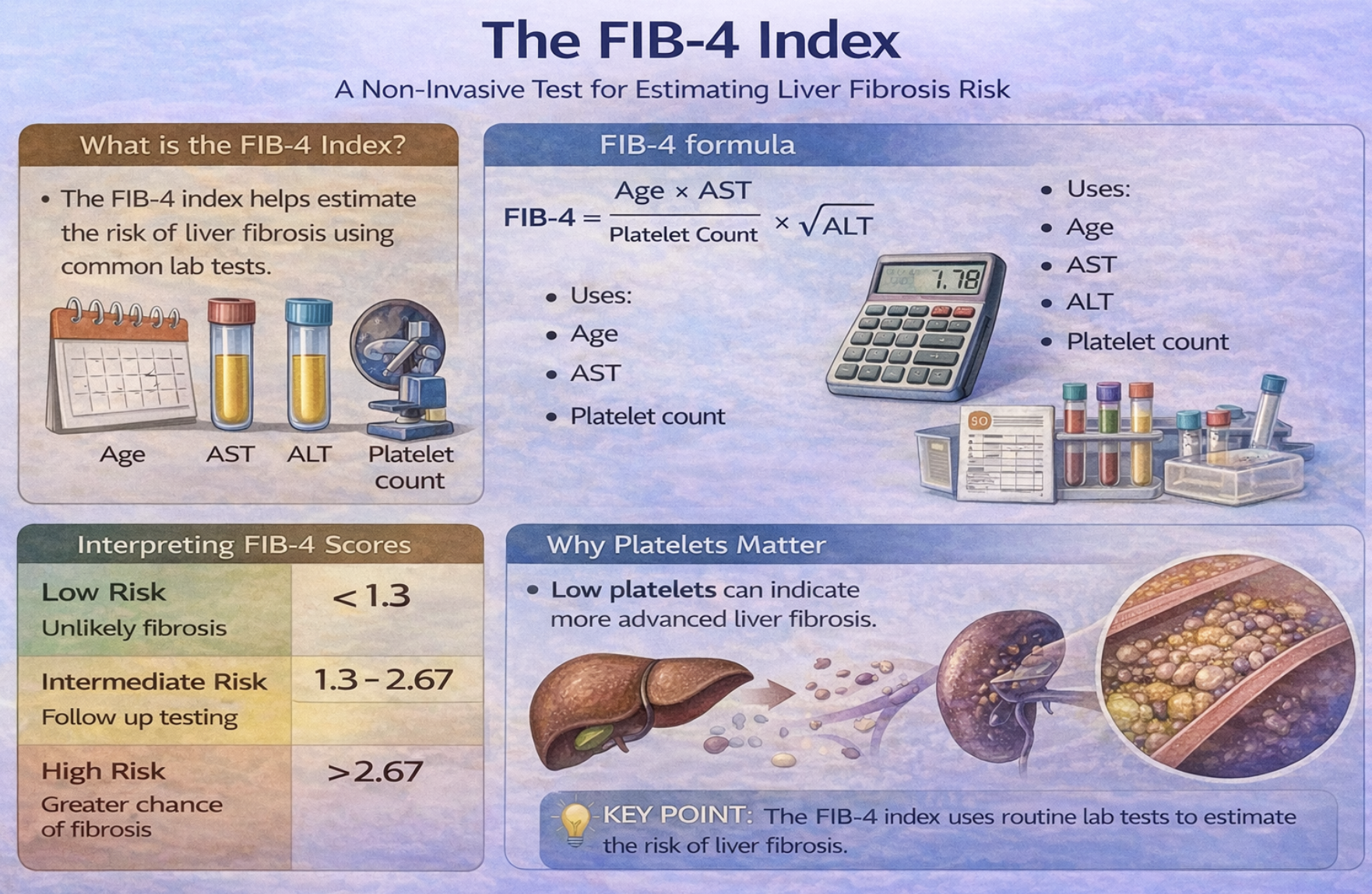
The FIB-4 index is a mathematical formula that estimates the likelihood of liver fibrosis using four commonly available clinical variables:
• age
• AST (aspartate aminotransferase)
• ALT (alanine aminotransferase)
• platelet count
Because these laboratory tests are often obtained during routine medical evaluation, the FIB-4 score can be calculated easily without additional testing.
This makes it a useful first-line screening tool in patients with metabolic risk factors.
FIB-4 = (Age × AST) / (Platelet Count × √ALT)
Where:
• Age is measured in years
• AST and ALT are measured in IU/L
• Platelet count is measured in platelets per microliter
Several online calculators are available to simplify this calculation in clinical practice.
Interpreting FIB-4 Scores
FIB-4 results are typically interpreted using threshold ranges that estimate fibrosis risk.
Commonly used categories include:
Low risk
FIB-4 less than approximately 1.3
Patients in this range are unlikely to have advanced fibrosis and may continue routine monitoring.
Intermediate risk
FIB-4 between 1.3 and 2.67
Further evaluation may be recommended, often using imaging techniques such as elastography.
High risk
FIB-4 greater than approximately 2.67
These patients may have a higher probability of advanced fibrosis and may benefit from specialist referral or further diagnostic evaluation.
Threshold values may vary slightly depending on clinical guidelines and patient population.
Why Platelets Matter
Platelet count is included in the FIB-4 calculation because platelet levels can decline in advanced liver fibrosis.
As fibrosis progresses, increased pressure within the liver and spleen may lead to sequestration or destruction of platelets. Lower platelet counts can therefore serve as an indirect indicator of more advanced liver disease.
Including platelet count in the FIB-4 formula helps improve the test’s ability to identify patients at risk for fibrosis.
FIB-4 and Metabolic Disease
The FIB-4 index is widely used in patients with metabolic risk factors such as:
• obesity
• insulin resistance
• type 2 diabetes
• metabolic syndrome
• fatty liver disease
Because MASLD often occurs alongside metabolic syndrome, the FIB-4 score helps clinicians determine which patients may require further evaluation for advanced liver disease.
In many cases, FIB-4 serves as an initial screening step before more specialized imaging or referral to hepatology.
Non-Invasive Fibrosis Assessment
The growing use of non-invasive tools such as FIB-4 reflects a broader shift in how clinicians evaluate liver disease.
Rather than relying solely on biopsy, clinicians increasingly combine laboratory scores with imaging techniques such as:
• transient elastography (FibroScan)
• magnetic resonance elastography
• other fibrosis scoring systems
These methods allow clinicians to identify high-risk patients while avoiding unnecessary invasive procedures.
Clinical Significance
Identifying liver fibrosis early is important because fibrosis stage strongly influences long-term outcomes in MASLD.
Patients with advanced fibrosis face higher risks of:
• cirrhosis
• liver failure
• hepatocellular carcinoma
• cardiovascular complications
Early detection allows clinicians to intervene by addressing underlying metabolic risk factors and monitoring disease progression.
Related Topics
Readers interested in the clinical evaluation of metabolic disease may also explore:
• Fatty Liver Disease (MASLD)
• Metabolic Syndrome
• Insulin Resistance
• De Novo Lipogenesis
These pages explain the metabolic pathways that contribute to liver fat accumulation and metabolic dysfunction.