Adenosine triphosphate (ATP) is the primary energy carrier within human cells. Nearly every biological process that requires energy—from muscle contraction to protein synthesis—depends on the availability of ATP.
Because ATP is so central to cellular function, changes in ATP balance can influence many metabolic pathways. When ATP levels decline within a cell, a series of compensatory biochemical responses may be activated to restore energy balance.
In metabolic research, ATP depletion has received particular attention in studies of carbohydrate metabolism, especially in relation to fructose processing in the liver. Investigating how cellular energy balance is affected by nutrient metabolism helps illuminate the broader physiology of metabolic stress.
ATP as the Cell’s Energy Currency
ATP functions as the universal energy molecule of living cells. It stores energy within high-energy phosphate bonds that can be released when the molecule is hydrolyzed.
When ATP loses one phosphate group it becomes adenosine diphosphate (ADP). Additional breakdown produces adenosine monophosphate (AMP).
These transformations allow cells to convert stored chemical energy into usable work for metabolic reactions.
To maintain normal function, cells continuously regenerate ATP through metabolic pathways such as:
• glycolysis
• oxidative phosphorylation
• fatty acid oxidation
• the citric acid cycle
Under stable conditions, ATP production and ATP consumption remain in balance.
Rapid ATP Consumption During Fructose Metabolism
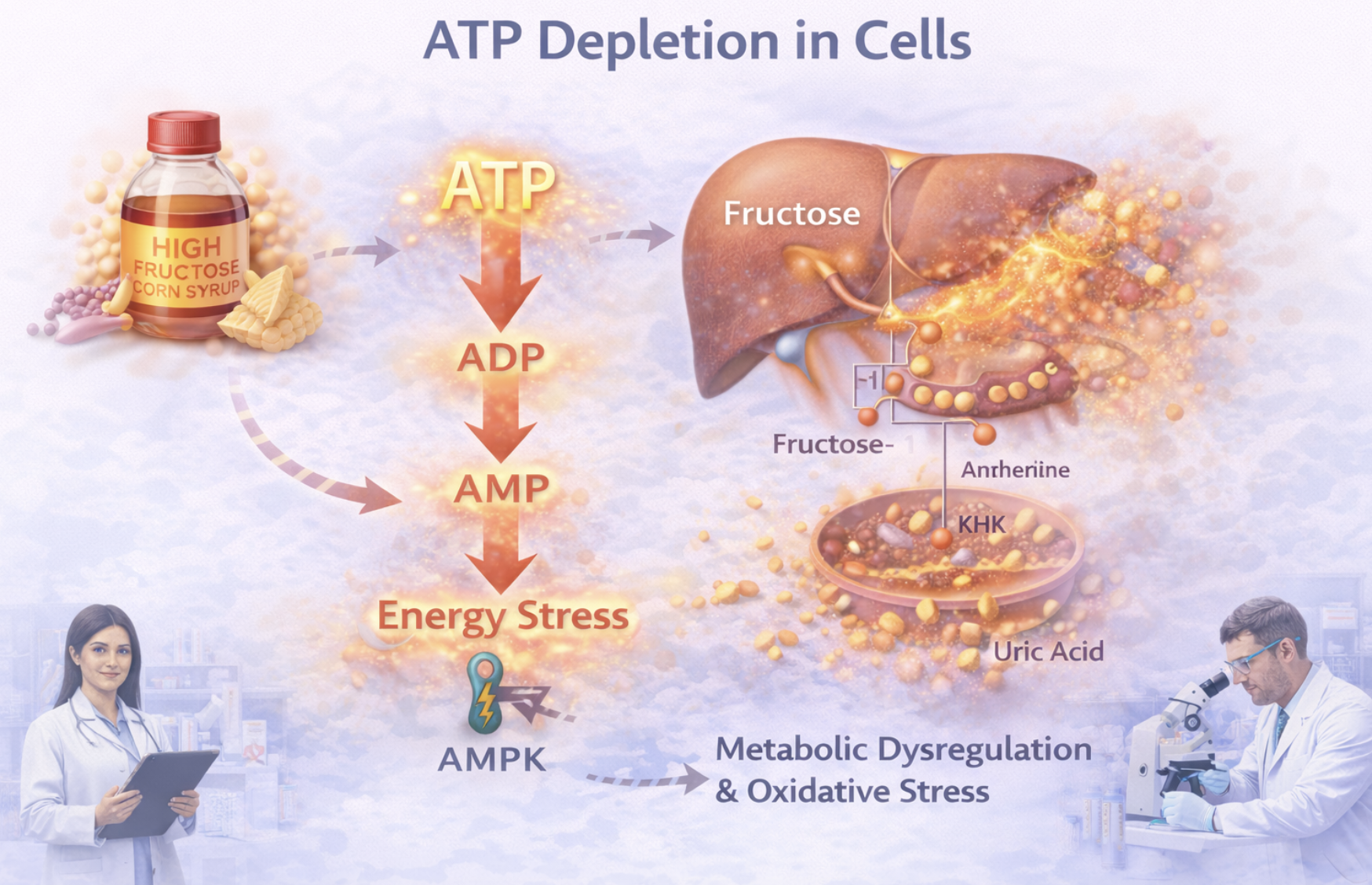
When fructose enters the liver, it is metabolized rapidly by the enzyme ketohexokinase (KHK).
This enzyme catalyzes the phosphorylation of fructose to form fructose-1-phosphate, a reaction that requires ATP. Unlike several steps in glucose metabolism, this reaction is not tightly regulated by feedback mechanisms.
Because of this lack of regulation, large quantities of fructose can be phosphorylated quickly within hepatocytes. During periods of high fructose exposure, this process can transiently reduce intracellular ATP levels.
Although liver cells typically restore ATP levels through metabolic compensation, repeated exposure to large substrate loads can generate temporary energy stress within hepatic cells.
Adenine Nucleotide Breakdown
When intracellular ATP levels decline, adenine nucleotides may be degraded in order to maintain cellular energy balance.
This breakdown process produces several intermediate compounds, eventually leading to the formation of uric acid.
For this reason, researchers have proposed that rapid ATP depletion during fructose metabolism may contribute to increased uric acid production.
The relationship between ATP depletion, nucleotide degradation, and uric acid generation remains an important topic in metabolic research.
Cellular Energy Sensors
Cells possess several molecular systems that detect changes in energy balance. One of the most important of these systems involves AMP-activated protein kinase (AMPK).
AMPK functions as a cellular energy sensor. When ATP levels decline and AMP levels rise, AMPK becomes activated. This activation triggers metabolic adjustments designed to restore energy balance.
These adjustments may include:
• increasing energy production pathways
• reducing energy-consuming processes
• promoting fatty acid oxidation
• altering glucose metabolism
Through these mechanisms, cells attempt to stabilize their internal energy state.
Energy Stress and Metabolic Signaling
Cellular energy balance influences numerous metabolic pathways.
When ATP depletion occurs repeatedly or chronically, metabolic signaling networks may adapt in ways that affect lipid metabolism, glucose regulation, and inflammatory pathways.
Some researchers have proposed that these energy-sensing pathways could contribute to broader metabolic changes associated with insulin resistance and fatty liver disease.
Although many details remain under investigation, the concept of cellular energy stress provides a useful framework for understanding how nutrient metabolism may influence systemic physiology.
The Liver and Energy Regulation
The liver plays a central role in managing cellular energy balance after meals.
Because it receives nutrients directly from the intestine through the portal circulation, the liver must rapidly process incoming carbohydrates, fats, and amino acids. These metabolic reactions influence ATP production and consumption within hepatocytes.
When nutrient exposure is excessive or frequent, hepatic energy metabolism may be placed under greater demand. The resulting changes in ATP dynamics may influence downstream metabolic signaling pathways.
Research Perspectives
The relationship between ATP depletion, fructose metabolism, uric acid production, and metabolic disease remains an active field of scientific investigation.
Researchers continue to study:
• how different nutrients affect cellular energy balance
• the role of ATP depletion in metabolic signaling
• interactions between hepatic metabolism and systemic physiology
• the long-term effects of repeated metabolic stress
These investigations aim to clarify the biochemical pathways that connect diet, metabolism, and chronic disease.