High Blood Pressure in the Metabolic Era
What is hypertension?
Hypertension means persistently elevated blood pressure.
Blood pressure reflects the force of blood pushing against the walls of the arteries. It is usually written as two numbers:
- systolic pressure — the pressure when the heart contracts
- diastolic pressure — the pressure when the heart relaxes
For many adults, hypertension is generally defined as blood pressure that remains elevated above normal on repeated measurement.
It is one of the most common chronic conditions in the world and one of the most important drivers of:
- heart disease
- stroke
- kidney disease
- heart failure
Why blood pressure matters
Blood pressure is not just a number.
When pressure remains high over time, it places continuous stress on:
- arteries
- the heart
- the kidneys
- the brain
This can gradually lead to:
- vascular damage
- thickening of the heart muscle
- reduced kidney function
- increased risk of stroke and cardiovascular events
Hypertension is often silent, but its long-term effects are not.
A common disease with many contributors
Most hypertension is described as primary or essential hypertension, meaning it does not arise from one single identifiable cause.
Instead, it reflects the combined effects of:
- genetics
- aging
- kidney handling of salt and water
- vascular tone
- body weight
- diet
- physical activity
- hormonal and metabolic factors
Some people also have secondary hypertension, in which blood pressure rises because of a specific medical condition such as:
- kidney disease
- hormonal disorders
- sleep apnea
- certain medications
Hypertension and metabolic syndrome
Hypertension is one of the core components of metabolic syndrome.
It commonly appears together with:
- central obesity
- insulin resistance
- elevated triglycerides
- low HDL cholesterol
- fatty liver disease
- elevated fasting glucose
This clustering is not random.
It reflects shared underlying processes, including:
- visceral adiposity
- insulin resistance
- inflammation
- altered kidney and vascular function
👉 See: Metabolic Syndrome Inflammation
The role of insulin resistance
Insulin resistance affects more than glucose control.
It can also influence blood pressure through several pathways:
- increased sympathetic nervous system activity
- altered sodium handling by the kidneys
- vascular dysfunction
- increased insulin levels that promote sodium retention
This means hypertension is often not an isolated cardiovascular problem. It is frequently part of a broader metabolic disorder.
👉 See: Insulin Resistance
Obesity, visceral fat, and blood pressure
Excess body fat — especially visceral fat — is strongly linked to hypertension.
Visceral adiposity contributes to:
- increased inflammation
- altered hormonal signaling
- increased vascular stiffness
- higher insulin resistance
- increased workload on the heart
Blood pressure often rises as weight and waist circumference rise, particularly when central obesity is present.
👉 See: Obesity / Central Obesity
The kidney connection
The kidneys play a central role in blood pressure regulation.
They help control:
- sodium balance
- water balance
- blood volume
- hormonal systems that influence vascular tone
When kidney handling of sodium becomes abnormal, blood pressure may rise.
This is one reason hypertension is so closely linked to:
- metabolic syndrome
- kidney disease
- uric acid metabolism
- dietary patterns
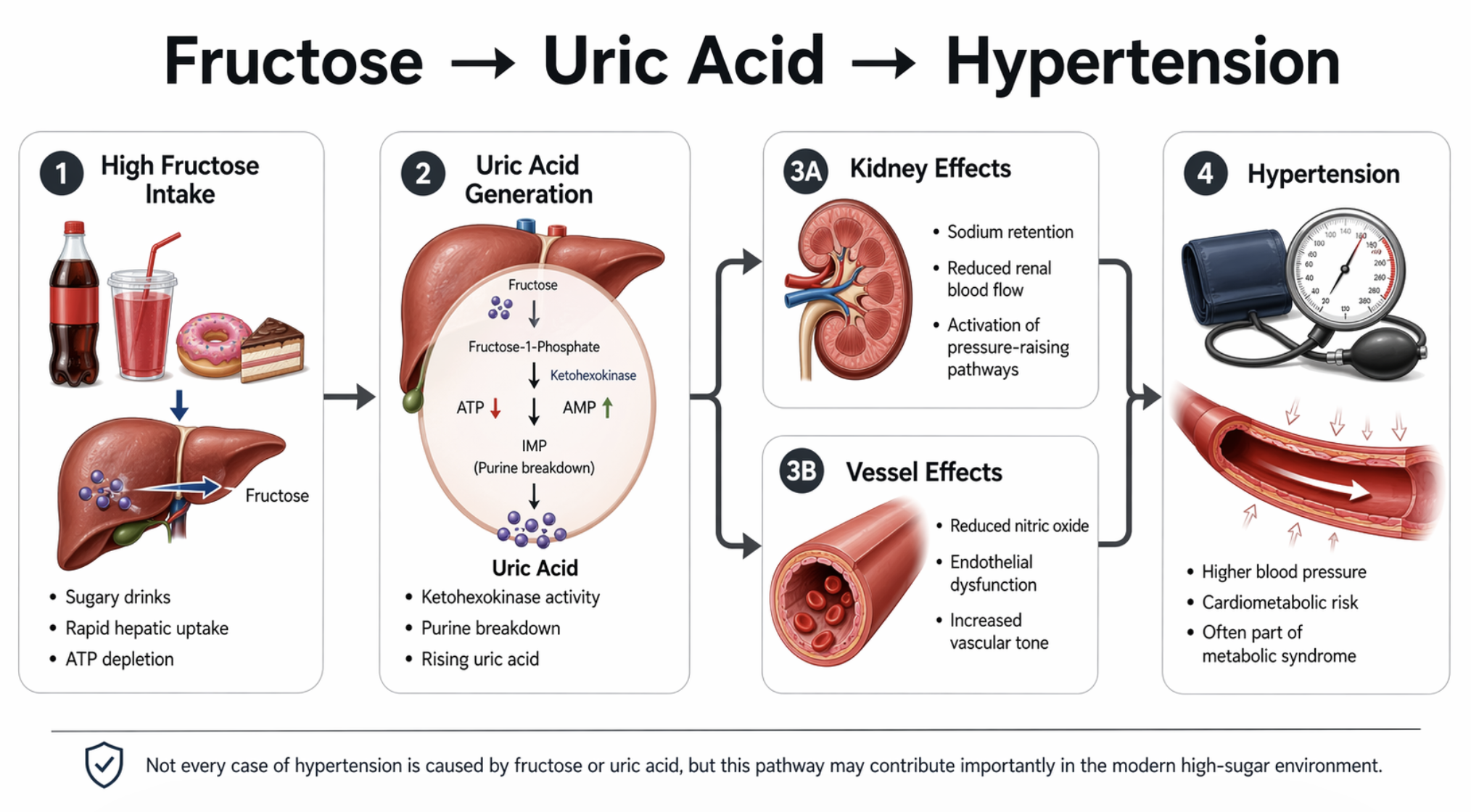
Fructose and uric acid: an important modern link
Hypertension does not have a single cause, and not all high blood pressure is caused by fructose or uric acid.
However, there is increasing interest in the role of fructose metabolism and uric acid in blood pressure regulation.
High fructose intake can:
- increase uric acid production
- promote liver fat accumulation
- worsen insulin resistance
- contribute to metabolic syndrome
Uric acid may then contribute to hypertension through effects on:
- endothelial function
- nitric oxide signaling
- kidney blood flow
- sodium retention
- vascular tone
This does not mean fructose explains every case of hypertension.
But in the modern food environment — especially where sugar-sweetened beverages are common — fructose and uric acid may contribute meaningfully to elevated blood pressure in some individuals.
👉 See: Fructose Metabolism
👉 See: Uric Acid
How fructose may influence blood pressure
Fructose is handled differently from glucose.
It is metabolized primarily in the liver and can rapidly deplete intracellular ATP, leading to:
- uric acid generation
- oxidative stress
- increased fat production
- insulin resistance
These changes may then influence blood pressure indirectly by promoting:
- vascular dysfunction
- metabolic overload
- renal sodium retention
- sympathetic activation
This helps place hypertension within the broader framework of the modern metabolic disease process.
Salt matters — but not by itself
Salt is often discussed as if it is the entire explanation for hypertension.
Salt can certainly matter, especially in salt-sensitive individuals. But hypertension in modern populations is usually more complex.
Blood pressure is often shaped by the interaction of:
- salt intake
- insulin resistance
- obesity
- kidney function
- vascular health
- uric acid
- overall dietary pattern
A person consuming a diet high in refined carbohydrates, sugary beverages, and ultra-processed foods may be exposed to multiple pressure-raising mechanisms at once.
Hypertension and sleep apnea
Sleep apnea is another important contributor to hypertension.
Repeated oxygen drops during sleep can lead to:
- sympathetic nervous system activation
- vascular stress
- worsening insulin resistance
This creates a strong overlap between:
- obesity
- sleep apnea
- hypertension
- metabolic syndrome
👉 See: Sleep Apnea
Hypertension and fatty liver
High blood pressure is also commonly associated with fatty liver disease (MASLD).
Both conditions often reflect the same underlying metabolic environment:
- excess caloric intake
- high fructose exposure
- insulin resistance
- visceral adiposity
This is another reason hypertension should not be viewed only as a cardiovascular problem.
👉 See: Fatty Liver Disease (MASLD)
Why hypertension is often silent
Most people with hypertension feel completely well.
This is why it is often called a silent disease.
Symptoms usually do not appear until complications develop. By then, damage may already have occurred in:
- the heart
- the brain
- the kidneys
- the blood vessels
That is why repeated measurement matters.
How hypertension is diagnosed
Hypertension is diagnosed using repeated blood pressure measurements, not a single reading taken once in a stressful situation.
Assessment may include:
- office blood pressure readings
- home blood pressure monitoring
- ambulatory blood pressure monitoring
This helps distinguish persistent hypertension from temporary elevation.
Clinical consequences
Over time, untreated hypertension can contribute to:
- coronary artery disease
- stroke
- chronic kidney disease
- heart failure
- atrial fibrillation
- vascular dementia
It is one of the most important modifiable risk factors in modern medicine.
Treatment
Treatment depends on severity, overall risk, and associated disease.
Approaches often include:
- weight reduction
- improvement in diet quality
- reduced intake of sugary beverages and ultra-processed foods
- physical activity
- better sleep
- reduction of excessive sodium intake in appropriate patients
- treatment of sleep apnea
- medication when needed
In many patients, treatment should address not only the blood pressure number, but also the broader metabolic environment.
A broader metabolic perspective
Hypertension is often presented as a stand-alone diagnosis.
In many patients, it is better understood as part of a larger pattern of metabolic dysfunction that includes:
- insulin resistance
- dyslipidemia
- fatty liver
- central obesity
- elevated uric acid
This broader view helps explain why blood pressure often improves when the underlying metabolic burden improves.
Bottom line
Hypertension is one of the most common and important manifestations of modern metabolic disease.
It reflects complex interactions between:
- vascular biology
- kidney function
- body fat distribution
- insulin resistance
- diet
- hormonal and inflammatory pathways
Fructose and uric acid are not the whole story, but they may be important contributors in the modern high-sugar food environment.
Understanding hypertension as part of a broader metabolic pattern helps place it in its proper clinical context.
Related pages
Metabolic Syndrome
Insulin Resistance
Uric Acid
Fructose Metabolism
Fatty Liver Disease (MASLD)
Sleep Apnea
Dyslipidemia
Cardiovascular Disease