Introduction
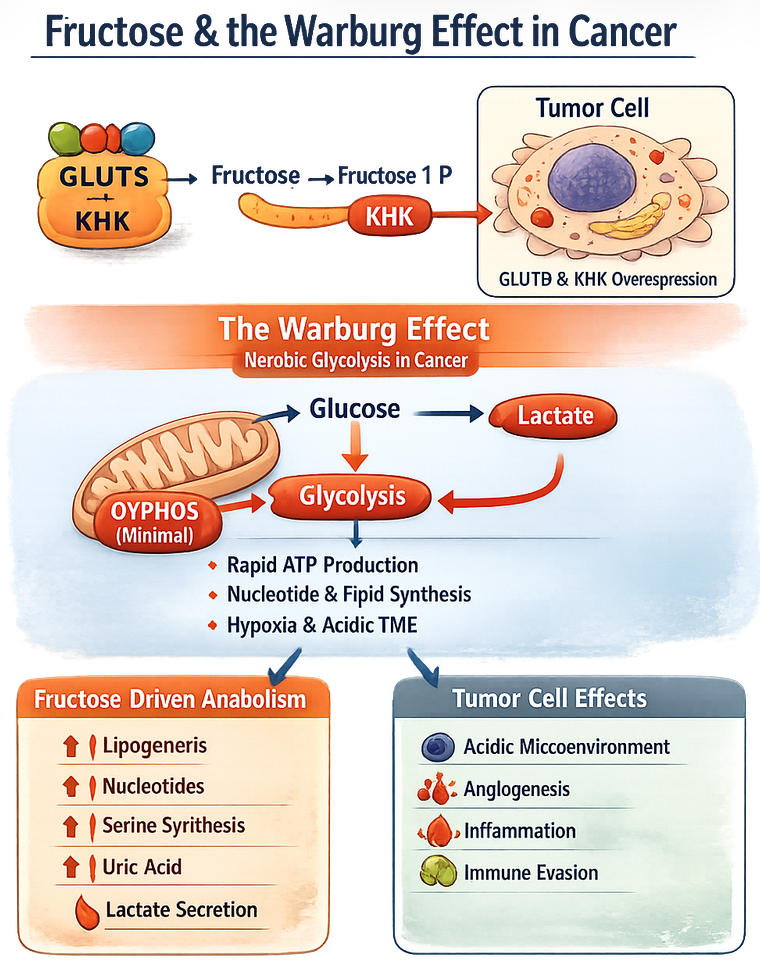
Under normal aerobic conditions, many differentiated cells convert glucose-derived pyruvate through the mitochondrial TCA cycle and oxidative phosphorylation to generate ATP efficiently.
The Warburg effect refers to a pattern of cellular metabolism in which cells rely heavily on glycolysis for energy production, even in the presence of adequate oxygen. In the Warburg effect, many cancer cells increase sugar uptake and convert a large fraction of glucose — and in some tumors, fructose-derived carbons — into lactate even when oxygen is available.
This metabolic pattern is most commonly discussed in the context of cancer biology, but it also provides insight into how cells adapt to changes in energy demand, nutrient availability, and metabolic signaling.
Normal Cellular Energy Metabolism
In most healthy cells, energy production follows a coordinated sequence:
- glucose enters the cell
- glycolysis produces pyruvate
- pyruvate enters mitochondria
- oxidative phosphorylation generates ATP efficiently
This pathway produces a large amount of ATP per molecule of glucose and is tightly regulated according to cellular energy needs.
What Changes in the Warburg Effect
In the Warburg effect, this balance shifts.
Even when oxygen is available:
- glycolysis becomes the dominant pathway
- pyruvate is converted into lactate
- mitochondrial oxidative phosphorylation is relatively reduced
This results in:
- less efficient ATP production per molecule
- higher rates of glucose uptake
- increased metabolic flux through glycolysis
Although less efficient per unit, this pathway can support rapid cellular activity by generating metabolic intermediates used for growth and biosynthesis. Cancer cells can get sugar in the form of fructose in low oxygen environments.
Why Cells Use This Pathway
Several factors may contribute to this metabolic shift:
- rapid energy demand
- need for building blocks (lipids, nucleotides, proteins)
- altered signaling pathways
- adaptation to cellular stress
In cancer cells, this pattern is thought to support proliferation by prioritizing growth over energy efficiency.
Transporters and Substrate Availability
Cells exhibiting the Warburg effect often increase the expression of nutrient transporters.
These may include:
- glucose transporters (such as GLUT1)
- fructose transporters such as <a href="/fructose-science/glut5">GLUT5</a>
This allows cells to take up larger quantities of available substrates.
Some studies suggest that fructose may serve as an additional metabolic input under certain conditions, entering pathways connected to glycolysis and lipid synthesis.
Connection to Fructose Metabolism
Fructose metabolism differs from glucose metabolism in several important ways.
After absorption through GLUT5, fructose is rapidly processed in the liver by ketohexokinase (KHK).
This pathway:
- bypasses key regulatory steps
- consumes ATP
- produces downstream intermediates
These intermediates may enter pathways related to:
- glycolysis
- lipid synthesis
- energy signaling
Because of this, fructose metabolism has been studied in relation to broader metabolic environments that include high substrate availability and altered energy handling.
Metabolic Context
The Warburg effect does not occur in isolation. It reflects a broader shift in cellular metabolism that can be influenced by:
- nutrient availability
- hormonal signaling
- mitochondrial function
- inflammatory pathways
In systemic metabolic conditions such as <a href="/metabolic-disease/insulin-resistance">insulin resistance</a> and <a href="/metabolic-disease/metabolic-syndrome">metabolic syndrome</a>, similar themes of altered energy handling, substrate excess, and metabolic adaptation are often observed.
A Systems Perspective
From a systems perspective, the Warburg effect illustrates how cells respond to changes in their metabolic environment.
When nutrients are abundant and signaling pathways are altered:
- energy pathways may shift
- substrate use may expand
- regulatory controls may change
These adaptations can be beneficial in short-term or specific contexts, but under sustained conditions they may contribute to broader metabolic imbalance.
Clinical and Research Perspective
The Warburg effect remains an active area of research.
Scientists continue to investigate:
- how metabolic pathways are regulated in different cell types
- how nutrient availability influences cellular behavior
- how these processes relate to disease development
Understanding these pathways may help clarify the links between metabolism, cellular signaling, and chronic disease.
Summary
The Warburg effect describes a shift toward glycolysis as a primary energy pathway, even in the presence of oxygen. This pattern is most often associated with cancer cells but reflects a broader principle of metabolic adaptation.
By examining how cells alter energy pathways under different conditions, the Warburg effect provides insight into how nutrient exposure, metabolic signaling, and cellular function are interconnected.