The Big Picture
Modern metabolic disease does not begin with diabetes.
It begins much earlier—with how the body handles sugar.
The key pathway is not random. It is structured, predictable, and increasingly visible in clinical practice:
Fructose → Liver → Uric Acid and Fat → MASLD →Systemic Disease
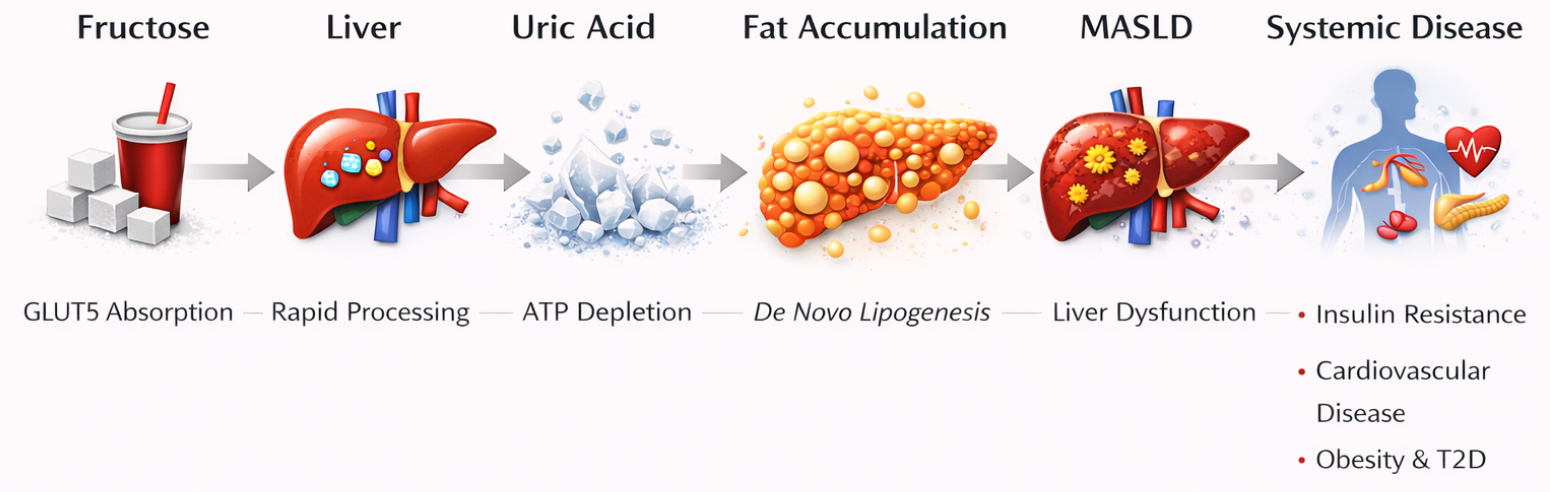
Understanding this arc changes how we detect, prevent, and treat disease.
Step 1 — Fructose Enters the System
Fructose is absorbed in the intestine via GLUT5.
Unlike glucose, it is not widely distributed to tissues.
Instead, it is delivered almost entirely to the liver.
Step 2 — Liver-First Metabolism
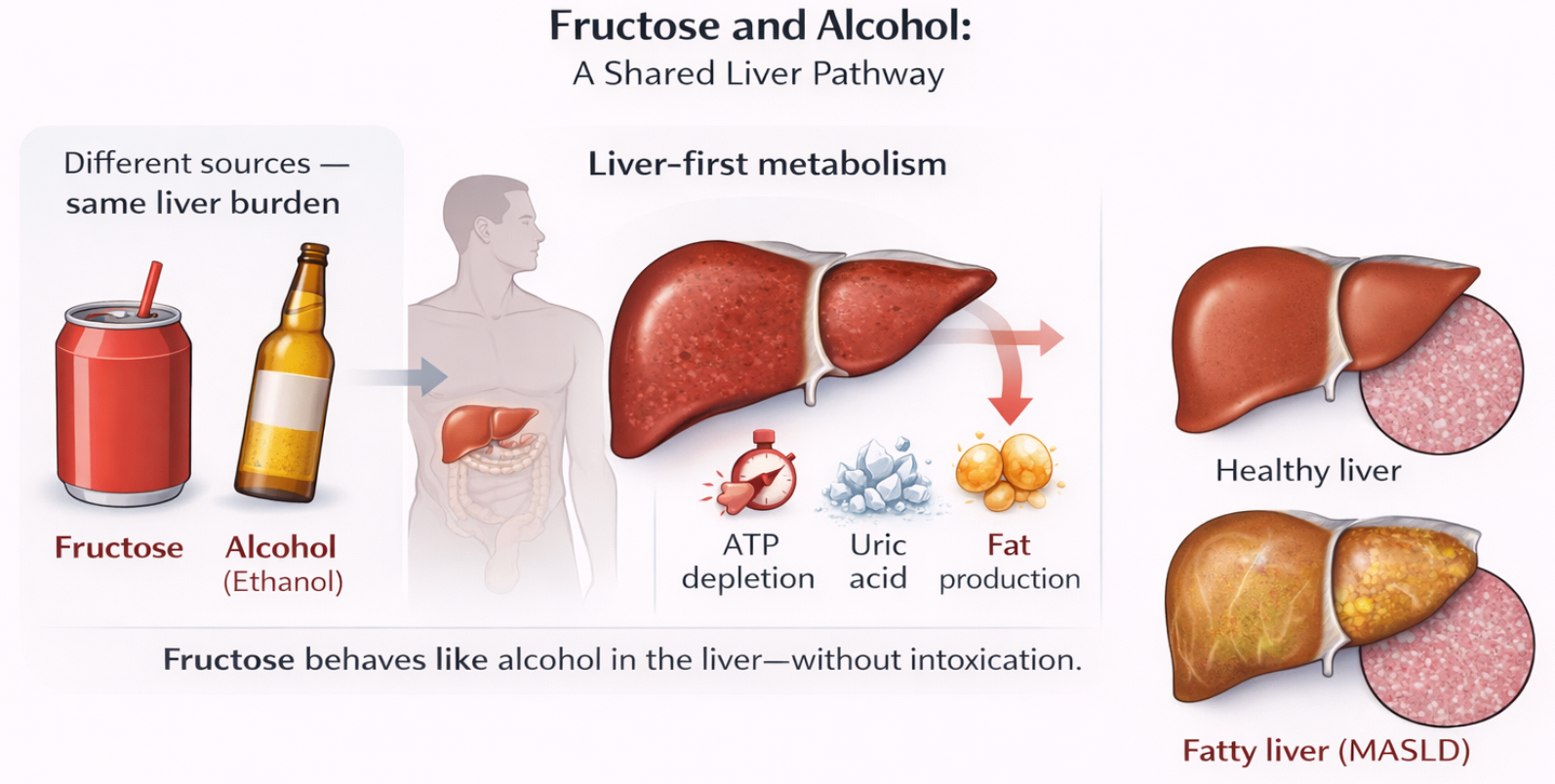
Modern work has clarified the metabolic handling of fructose in the liver. Research from groups including Robert Lustig’s at UCSF has emphasized that high-dose fructose bypasses key regulatory steps and promotes hepatic fat production, providing a mechanistic framework linking dietary sugar to metabolic disease. The group also demonstrated that fructose metabolism in the liver is identical to that of alcohol.
In the liver, fructose is rapidly processed by Ketohexokinase.
This step:
- bypasses key regulatory checkpoints
- consumes ATP rapidly
- proceeds regardless of energy status
This is the first critical inflection point.
Step 3 — ATP Depletion → Uric Acid
As ATP is consumed:
- AMP accumulates
- AMP is degraded
- Uric acid is produced
This links fructose metabolism directly to rising uric acid.
Step 4 — Uric Acid as a Signal
Elevated uric acid is not passive.
It actively contributes to:
- endothelial dysfunction
- reduced nitric oxide
- Insulin resistance
- mitochondrial stress
It is both:
- a marker
- and a mediator
Step 5 — Fat Production in the Liver
Excess substrate is converted into fat through de novo lipogenesis.
This leads to:
- triglyceride accumulation
- fat export (VLDL)
- hepatic fat storage
The result is:
→ Metabolic dysfunction–associated steatotic liver disease
Step 6 — The Liver as the Hub
MASLD is not an isolated condition. It is the central node in a broader metabolic network:
- insulin resistance worsens
- triglycerides rise
- inflammatory signaling increases
From here, disease spreads systemically.
Step 7 — Systemic Spillover
Once established, the process extends beyond the liver:
Metabolic Effects
- worsening insulin resistance
- progression to Type 2 diabetes
Cardiovascular Effects
- endothelial dysfunction
- vascular stiffness
- atherosclerotic risk
Cardio-Hepatic Axis
- inflammation and adipokine signaling
- progression toward HFpEF (heart failure with preserved ejection fraction)
This aligns with emerging cardiology frameworks linking metabolic overload to cardiac dysfunction.
Step 8 — Clinical Expression
By the time disease is clinically obvious, the process has often been present for years:
- fatty liver
- elevated triglycerides
- rising uric acid
- central obesity
- impaired glucose control
The arc is already well underway.
Why This Arc Matters
This model explains several otherwise confusing observations:
- Why fatty liver appears early
- Why uric acid rises before diabetes
- Why triglycerides increase disproportionately
- Why “normal weight” individuals can still be metabolically unhealthy
It also explains why:
treating late-stage disease misses the upstream driver.
Where to Intervene
The earlier the intervention, the more effective it is.
Highest-Leverage Point
Reduce chronic fructose exposure
- especially sugar-sweetened beverages
Early Clinical Signals
- uric acid
- triglycerides
- liver fat
Structural Approach
- diet
- activity
- early screening
The Unifying Concept
This is not a collection of unrelated diseases.
It is a single metabolic process expressing itself in different organs:
- liver → MASLD
- pancreas → diabetes
- vasculature → cardiovascular disease
- heart → HFpEF
Same pathway. Different endpoints.
Where This Connects
Bottom Line
The modern metabolic crisis follows a clear biological arc:
Fructose → Liver → Uric Acid → Fat → MASLD →Systemic Disease
Recognizing that arc early allows intervention before irreversible damage occurs.
Ignoring it means treating consequences rather than causes.