Uric acid pathway
From fructose chemistry to clinical disease
These pages separate the biochemistry of uric acid from the clinical syndromes of high uric acid, gout, hypertension, kidney disease, and metabolic overload.
From Fructose Metabolism to Urate and Crystal Formation
Uric acid is often introduced through gout, kidney stones, or “high uric acid” on a blood test. But before it becomes a clinical problem, it is a biochemical molecule with a very specific story.
It sits at the end of purine breakdown, rises when cells burn through ATP, and changes physical behavior depending on concentration, pH, sodium, temperature, and local tissue conditions. That is why uric acid forms an elegant bridge between fructose metabolism, energy stress, and crystal chemistry.
This page focuses on uric acid as chemistry and biochemistry. Clinical syndromes such as gout, hyperuricemia, hypertension, and kidney disease are covered elsewhere.
What is uric acid?
Uric acid is the final product of purine metabolism in humans.
Purines are part of:
- DNA and RNA
- ATP and related energy molecules
- normal cellular turnover
- some foods
As purines are broken down, they are eventually converted into uric acid.
Humans are unusual because, unlike many mammals, we do not efficiently convert uric acid into allantoin. As a result, uric acid levels in humans remain relatively high.
Why uric acid matters in fructose biology
In fructose metabolism, uric acid is not just a waste product.
Fructose is metabolized rapidly in the liver. Once it enters hepatocytes, it is phosphorylated by ketohexokinase (KHK). That step consumes ATP quickly. As ATP falls, AMP rises, and AMP can then be degraded through the purine pathway, ultimately generating uric acid.
The simplified sequence is:
Fructose → KHK activation → ATP depletion → AMP accumulation → purine breakdown → uric acid
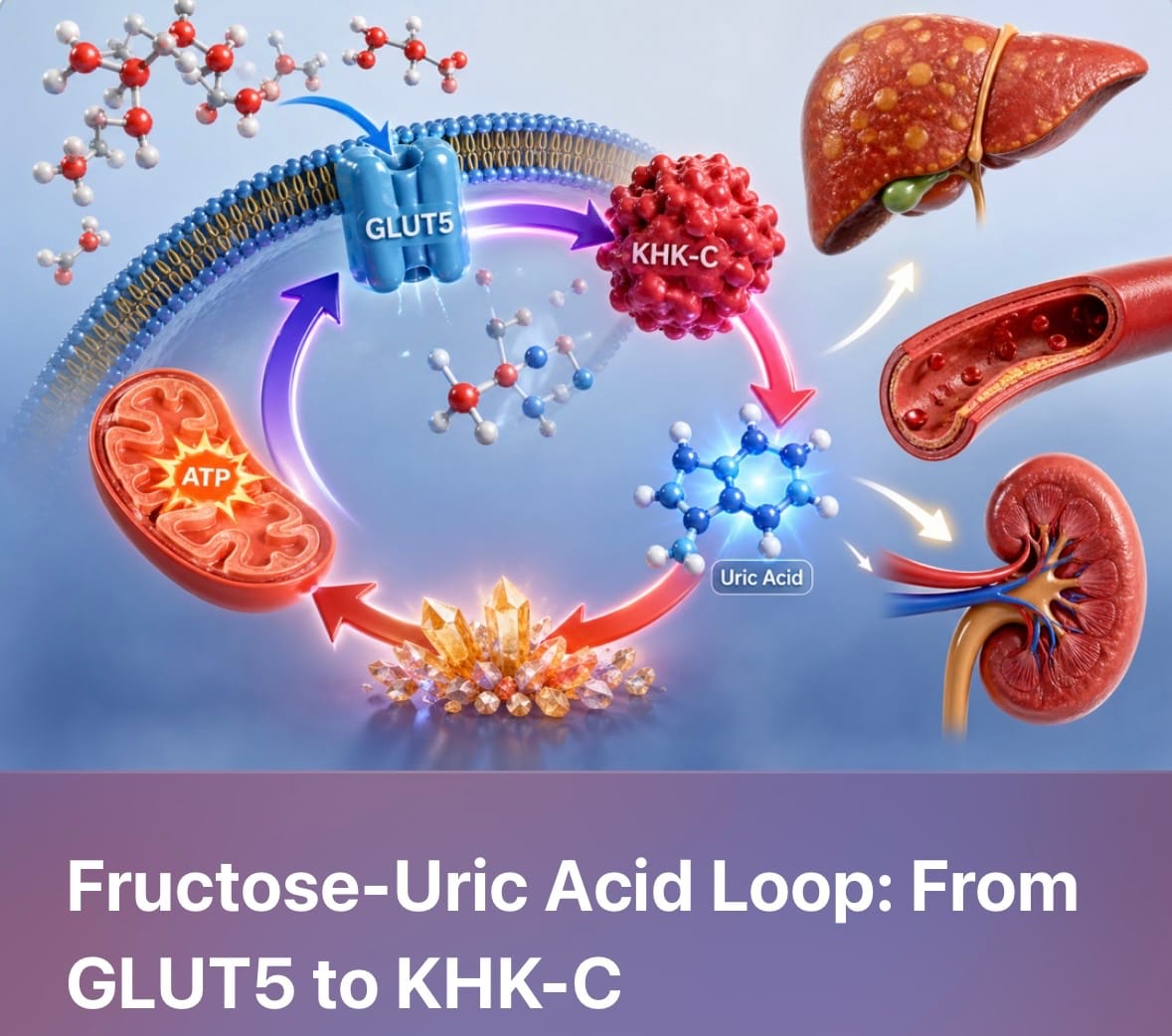
This is one of the main biochemical reasons fructose behaves differently from glucose.
Purine breakdown
The purine pathway can be simplified like this:
- ATP depletion increases AMP
- AMP is degraded to hypoxanthine
- hypoxanthine is converted to xanthine
- xanthine is converted to uric acid
The key enzyme near the end of the pathway is xanthine oxidoreductase.
This pathway is active in normal metabolism, but it becomes especially important when there is:
- rapid ATP depletion
- high fructose exposure
- tissue stress
- high nucleic acid turnover
Uric acid versus urate
This distinction matters.
Strictly speaking:
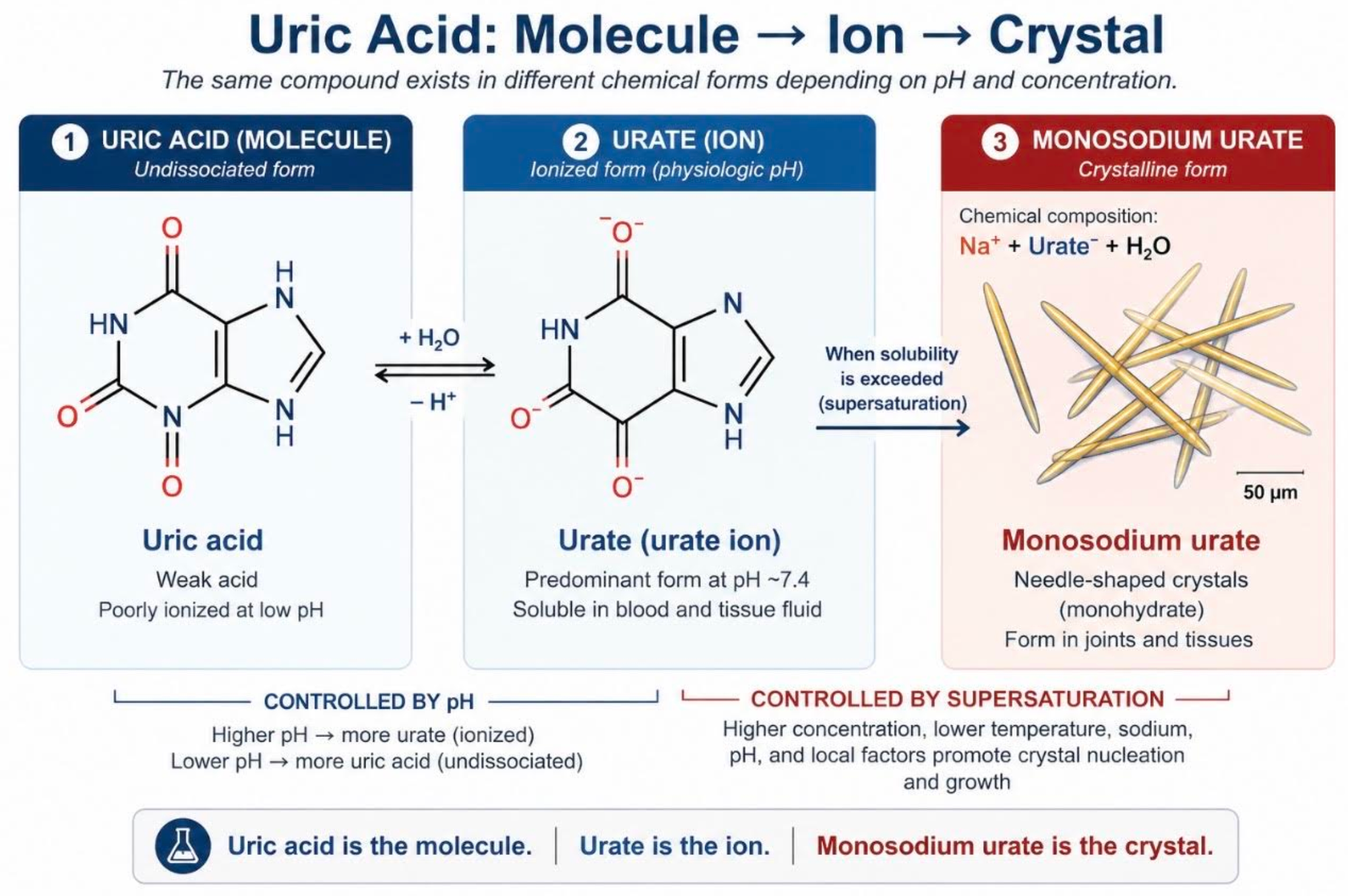
- uric acid is the protonated form
- urate is the ionized form
At physiologic pH, much of the molecule exists as urate, especially monosodium urate in body fluids.
So in practice:
- “uric acid” is the general term
- “urate” is often the dominant dissolved form in blood and extracellular fluid
Three states that matter
The clearest way to understand uric acid chemistry is to think of it in three states:
1. Dissolved urate
This is the usual circulating form in body fluids.
2. Supersaturation
As concentration rises, the fluid approaches the limit of solubility.
3. Crystal formation
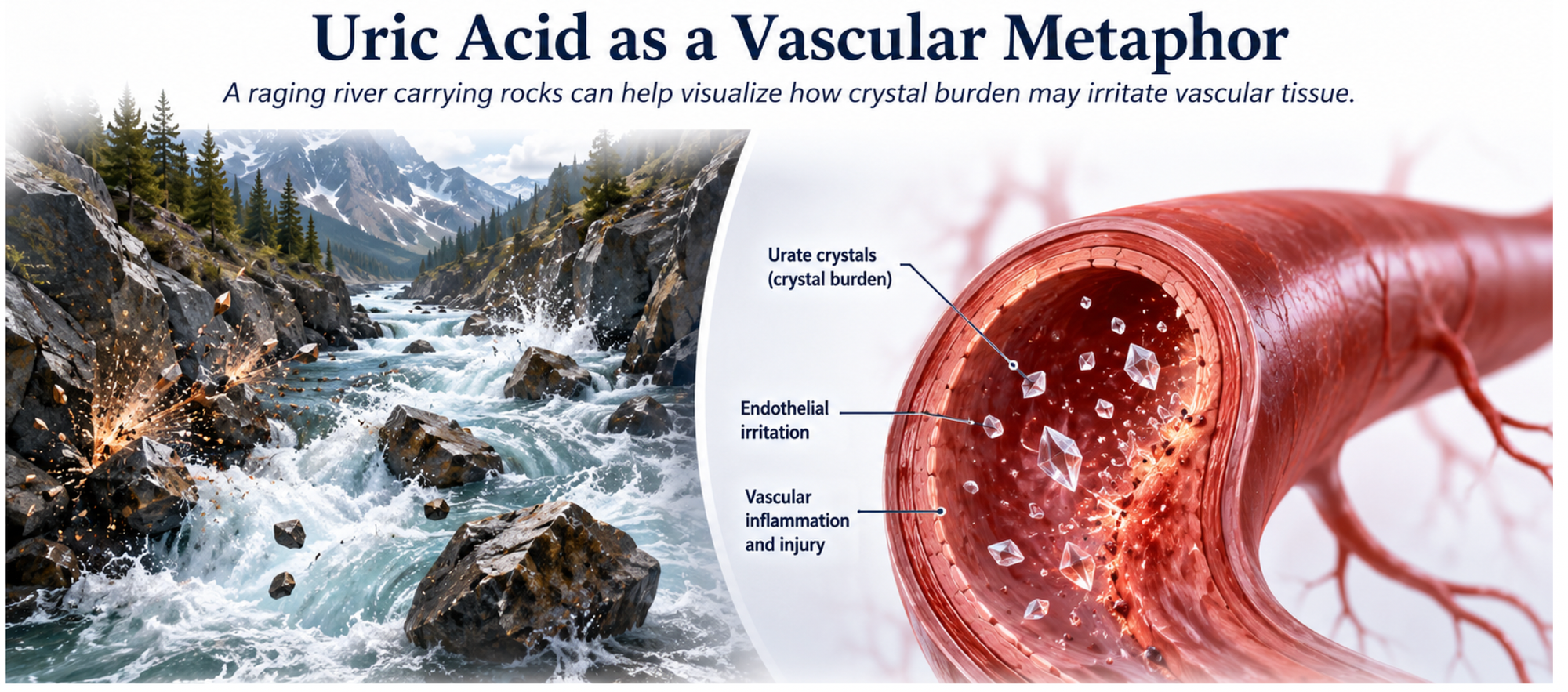
When local conditions favor precipitation, urate can leave solution and form monosodium urate crystals. In acidic urine, uric acid crystals may form.
This transition from dissolved molecule to solid crystal is where chemistry becomes clinically important.
Why crystals form
Crystal formation depends on more than the total amount of uric acid.
Important factors include:
- concentration
- pH
- sodium concentration
- temperature
- hydration
- local tissue environment
Cooler temperatures favor crystal formation. Acidic urine favors uric acid precipitation.
So uric acid chemistry is not simply “high or low.” It is a balance between solubility and precipitation.
Uric acid as a signal of energy stress
Uric acid is best understood in more than one way.
It is:
- the end product of purine metabolism
- a marker of rapid ATP depletion
- a signal of metabolic stress
- a molecule whose solubility changes with local chemistry
That is why it is so important in fructose biology.
Fructose can increase uric acid not merely because of diet, but because of how it stresses liver energy metabolism.
Why humans are vulnerable
Humans live relatively close to the threshold at which urate can leave solution.
Because we lack effective uricase activity:
- uric acid levels are higher than in many other mammals
- solubility limits matter more
- changes in diet and metabolism may have greater consequences
This makes uric acid especially relevant in the modern food environment.
Bottom line
Uric acid is more than a lab number.
It is:
- the end product of purine breakdown
- a marker of ATP depletion
- a chemical species that shifts between dissolved urate and solid crystal depending on pH, concentration, and local conditions
In fructose biology, it matters because excess fructose can drive rapid ATP depletion in the liver and increase uric acid production.
That makes uric acid one of the clearest biochemical links between fructose metabolism, liver energy stress, and downstream disease biology.