Ancient Foods With Modern Metabolic Value
A food group found across the world
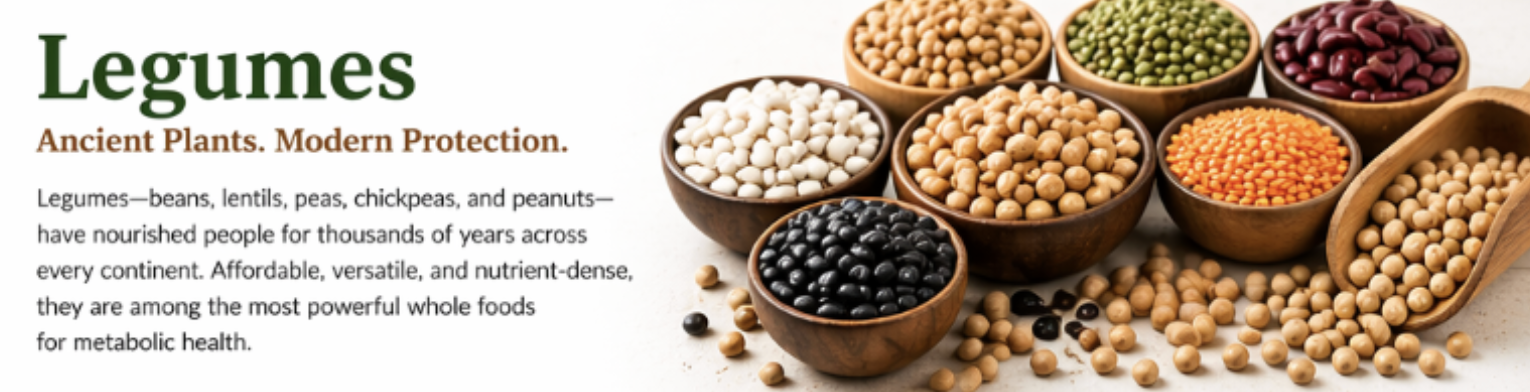
Legumes have nourished human populations for thousands of years. Across Africa, Asia, the Middle East, Europe, and the Americas, traditional diets have long depended on foods such as:
- beans
- lentils
- chickpeas
- peas
- soybeans
- broad beans
- black beans
- kidney beans
These foods were not side dishes in the modern sense. In many cultures, they were core staples.
They provided affordable, durable, nutrient-dense nourishment in settings where meat was scarce, expensive, or eaten only occasionally.
What are legumes?
Legumes are plants in the bean and pea family, particularly their edible seeds.
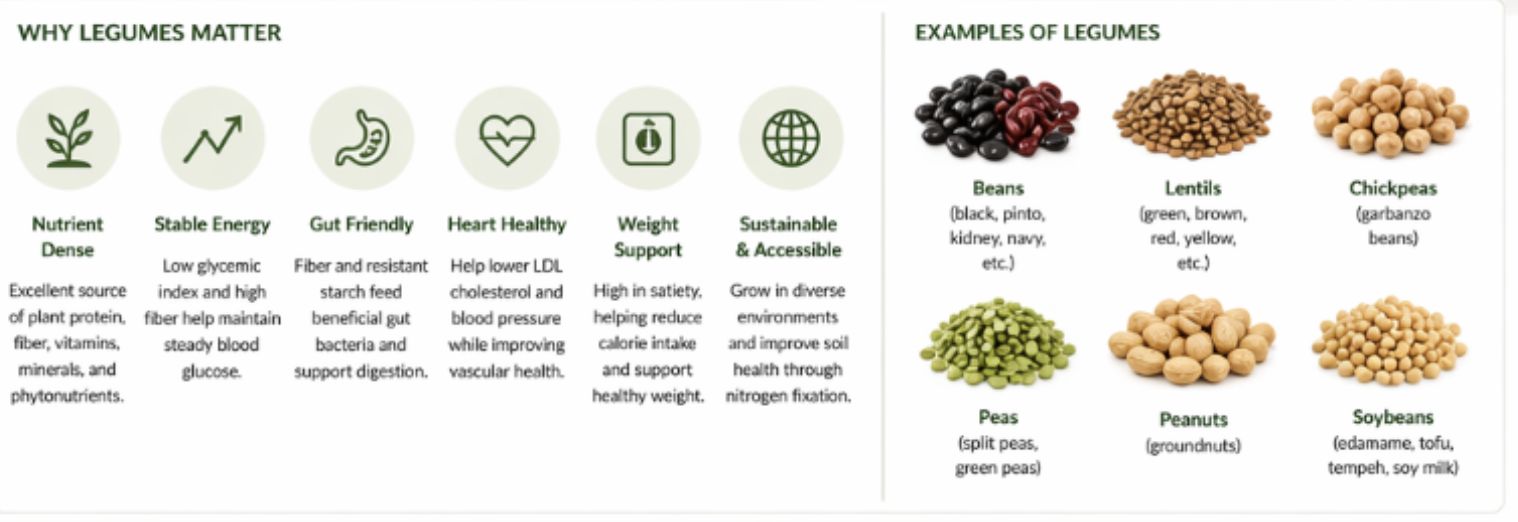
Common examples include:
- lentils
- chickpeas
- black beans
- kidney beans
- pinto beans
- navy beans
- split peas
- soybeans
They are important because they combine several useful features in one food:
- plant protein
- fiber
- complex carbohydrate
- minerals
- low sugar content
This gives them a very different metabolic profile from refined starches or sugary processed foods.
What legumes have in common
In their traditional cooked form, legumes are generally:
- high in fiber
- rich in plant protein
- relatively low in sugar
- low in fructose
- slow to digest compared with refined grains
They also tend to support:
- steadier energy release
- greater fullness after meals
- lower glycemic impact than many processed carbohydrates
This matters in a modern food environment dominated by rapidly absorbed calories.
A globally important traditional food
Legumes appear repeatedly in some of the world’s most stable traditional food systems.
Examples include:
- lentils and chickpeas in the Middle East and Mediterranean
- beans and maize in Latin America
- peas, lentils, and dals across South Asia
- beans in African food systems
- soy-based foods in East Asia
This broad geographic presence suggests something important:
👉 legumes have long been compatible with human metabolic health across many environments.
Why legumes are metabolically different
Legumes are not simply “carbohydrates.”
Their metabolic behavior is shaped by:
- fiber
- intact structure
- protein content
- slower digestion
This means they are usually absorbed more gradually than:
- white bread
- sweetened breakfast cereals
- crackers
- snack foods
- refined flour products
The difference is not just nutrient content. It is also food structure.
Legumes and blood sugar
Legumes often have a lower glycemic effect than refined grains.
That means they generally:
- produce a slower rise in blood glucose
- reduce sharp spikes in insulin demand
- provide more sustained satiety
This makes them especially useful in dietary patterns aimed at metabolic stability.
They are not magic foods, but they are often safer and more stable than many modern processed starches.
Fiber, satiety, and meal structure
One of the most important features of legumes is fiber.
Fiber helps:
- slow digestion
- support fullness
- reduce rapid absorption
- support gut health
In traditional diets, legumes are often eaten in structured meals rather than as snack foods.
That matters.
A meal based on beans, lentils, or chickpeas behaves very differently from a meal based on refined flour and sugary beverages.
Legumes as protein and carbohydrate together
Legumes are unusual because they provide both:
- carbohydrate
- meaningful protein
This gives them a more balanced profile than many starch-heavy foods.
In traditional diets, legumes often helped reduce dependence on:
- refined grains
- excessive meat intake
- processed protein products
They were a practical, affordable, metabolically stable food source long before modern nutrition labels existed.
Examples of major legumes
Lentils
Lentils are one of the oldest cultivated foods in human history.
They are:
- quick to cook
- rich in fiber
- high in plant protein
- widely used in soups, stews, and dals
Lentils are a classic example of a stable traditional food.
Chickpeas
Chickpeas are central to Mediterranean and Middle Eastern diets.
They are used in foods such as:
- hummus
- stews
- salads
- roasted chickpea preparations
They combine fiber, starch, and protein in a compact whole-food form.
Beans
Beans come in many forms, including:
- black beans
- kidney beans
- pinto beans
- navy beans
- cannellini beans
They are especially important in the Americas and Africa, where they have long been paired with grains or root crops in traditional meals.
Peas and split peas
Peas and split peas are traditional staples in many parts of Europe, South Asia, and Africa.
They are often underappreciated, but they provide many of the same benefits seen in beans and lentils.
Soybeans
Soybeans are a major traditional legume in East Asia.
In traditional forms such as:
- tofu
- tempeh
- edamame
- miso
they can be part of a stable dietary pattern.
As always, traditional food forms differ from highly processed industrial versions.
Legumes versus modern processed foods
This is the key comparison.
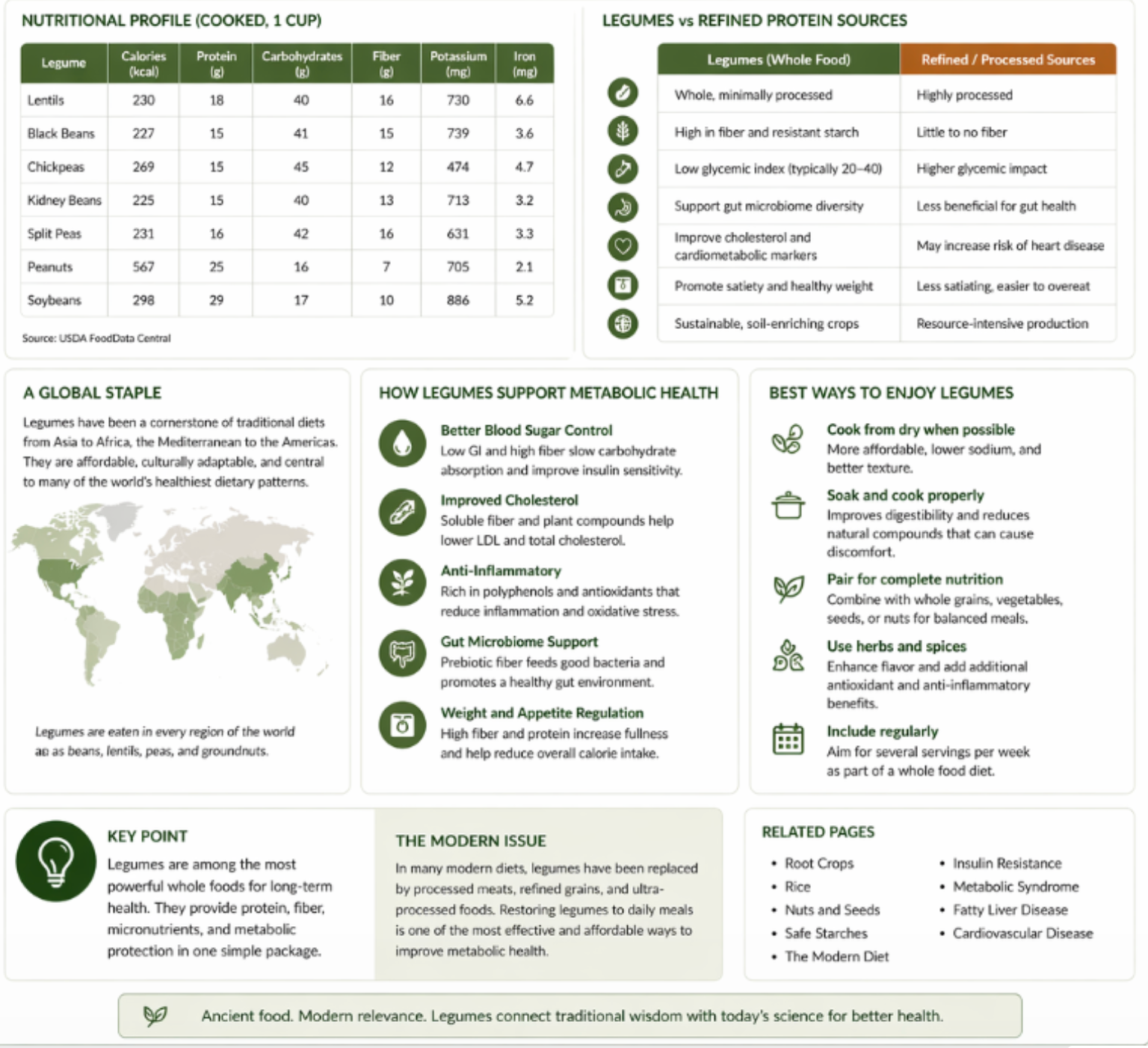
Traditional legumes are typically:
- whole or minimally processed
- cooked and eaten as meals
- combined with vegetables, grains, or other whole foods
- rich in fiber and structure
Modern processed foods are often:
- low in fiber
- rapidly absorbed
- high in refined starch
- heavily salted, sweetened, or engineered for overconsumption
The metabolic difference is substantial.
Preparation matters
As with root crops, preparation changes the metabolic impact.
Boiled, stewed, or traditionally prepared legumes are very different from:
- heavily salted canned products with additives
- deep-fried snack foods made from legumes
- sweetened or ultra-processed packaged products
Traditional preparation preserves structure. Industrial processing often undermines it.
Legumes and the modern diet
One of the major changes in modern food systems is that legumes have often been displaced by:
- refined flour products
- processed meats
- snack foods
- sugary convenience foods
This replacement matters.
Legumes are filling, slow, structured foods. Processed foods are often fast, soft, refined, and easy to overconsume.
In metabolic terms, that is a major shift.
Why legumes matter now
In the modern metabolic environment, legumes remain highly relevant.
They may help by:
- lowering reliance on refined carbohydrates
- improving satiety
- supporting steadier blood sugar patterns
- providing affordable whole-food nutrition
They also fit well into many traditional dietary patterns that have historically been associated with better metabolic health.
The real modern issue
The problem is not that people stopped eating “healthy ingredients.”
The problem is that many populations replaced legumes with foods that are:
- more refined
- more rapidly absorbed
- less filling
- more heavily marketed
- easier to eat continuously throughout the day
This is part of the broader global transition from structured traditional diets to industrial food environments.
Bottom line
Legumes are among the most important traditional foods in human history.
In their minimally processed forms, they provide:
- fiber
- plant protein
- structured carbohydrate
- micronutrients
- greater metabolic stability than many refined modern foods
The key distinction is not simply “plant protein” or “carbohydrate.”
It is:
👉 traditional legumes versus refined industrial foods
Related pages
Root Crops
Rice
Bread
Safe Foods
The Modern Diet
Global Metabolic Transition
Metabolic Syndrome