Introduction: Food Processing
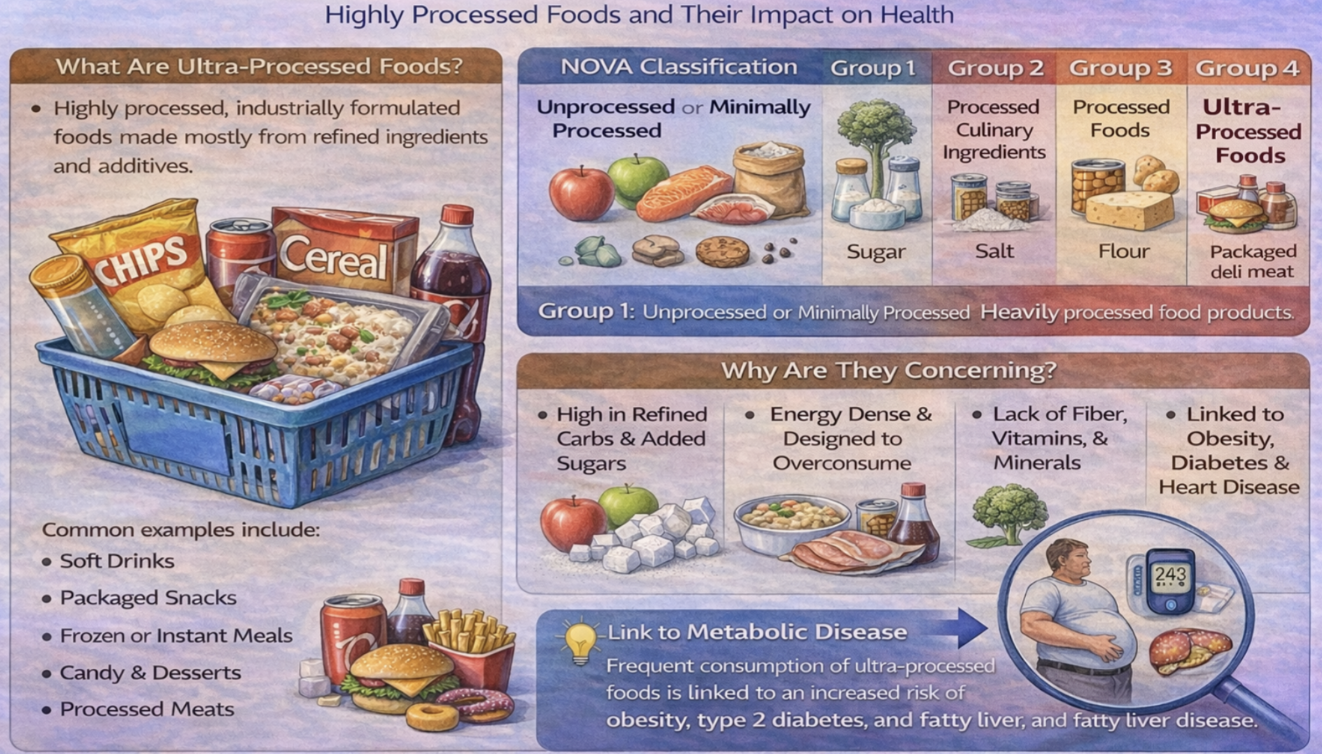
Food processing has long played a role in human nutrition. Techniques such as drying, fermenting, cooking, and preserving allowed earlier societies to store food and improve its safety.
In recent decades, however, a new category of foods has become increasingly prominent in many diets: ultra-processed foods.
Ultra-processed foods are industrial formulations created primarily from refined ingredients, additives, and manufactured components rather than whole foods. These products are typically designed for convenience, long shelf life, and highly consistent flavor and texture.
The growing consumption of ultra-processed foods has coincided with the global rise of metabolic diseases such as obesity, type 2 diabetes, and fatty liver disease. For this reason, researchers have begun examining how modern food systems influence metabolic health.
What Are Ultra-Processed Foods?
Nutrition researchers often classify foods according to the degree of industrial processing they undergo.
Ultra-processed foods are typically characterized by:
• ingredients derived from refined starches, sugars, or oils
• food additives such as flavor enhancers, emulsifiers, and stabilizers
• extensive industrial manufacturing processes
• minimal intact whole-food ingredients
Examples may include:
• sweetened beverages
• packaged snack foods
• confectionery and desserts
• many ready-to-eat meals
• certain processed meat products
These foods often contain combinations of refined carbohydrates, added sugars, and fats that are uncommon in traditional dietary patterns.
Energy Density and Palatability
Ultra-processed foods are frequently designed to be highly palatable. Through careful combinations of sweetness, saltiness, and fat content, these foods may stimulate reward pathways that encourage repeated consumption.
Many ultra-processed foods are also energy dense, meaning they contain a large number of calories relative to their weight or volume.
Because these products are easy to consume quickly and require little preparation, they may contribute to increased caloric intake in some individuals.
Refined Carbohydrates and Added Sugars
Another common feature of ultra-processed foods is the use of refined carbohydrates and added sugars.
Industrial processing often removes fiber and structural components from whole grains or other plant foods. The resulting refined ingredients can be rapidly digested and absorbed.
Added sugars—including sucrose and high-fructose corn syrup—are frequently used to enhance flavor and preserve products. These sugars contribute to total carbohydrate intake and influence metabolic pathways discussed elsewhere on this site, including fructose metabolism and lipid synthesis in the liver.
Dietary Patterns and Metabolic Health
Large observational studies have found associations between high consumption of ultra-processed foods and increased rates of obesity, metabolic syndrome, and other metabolic disorders.
Several factors may contribute to these relationships:
• increased caloric intake
• altered nutrient composition
• reduced dietary fiber
• rapid absorption of refined carbohydrates
• changes in satiety signaling
Because these factors often occur together, it can be difficult to isolate the effects of individual ingredients.
Nevertheless, many researchers believe that the overall structure of modern food environments plays an important role in metabolic health.
Decline of Traditional Dietary Patterns
The rise of ultra-processed foods has occurred alongside major changes in global food systems.
Urbanization, globalization of agriculture, and industrial food manufacturing have made packaged foods widely available in both developed and developing countries. At the same time, traditional dietary patterns based on minimally processed foods have declined in many regions.
This transition has occurred rapidly compared with the pace of human biological adaptation.
Understanding how these changes interact with human metabolism is a central theme of research into the modern metabolic crisis.
A Systems Perspective
Ultra-processed foods illustrate how the food environment can influence metabolic physiology.
The biological mechanisms discussed throughout this site—such as insulin signaling, hepatic lipid synthesis, and inflammatory pathways—do not operate independently of diet. Instead, they respond continuously to patterns of nutrient exposure.
When dietary patterns shift dramatically, metabolic systems must adapt to new conditions.
Examining both the biological pathways and the environmental factors influencing them provides a more complete understanding of modern metabolic disease.
Related Topics
Readers interested in exploring these ideas further may also consult:
• GLUT-5
These pages examine the biological and environmental factors that interact in modern metabolic disease.