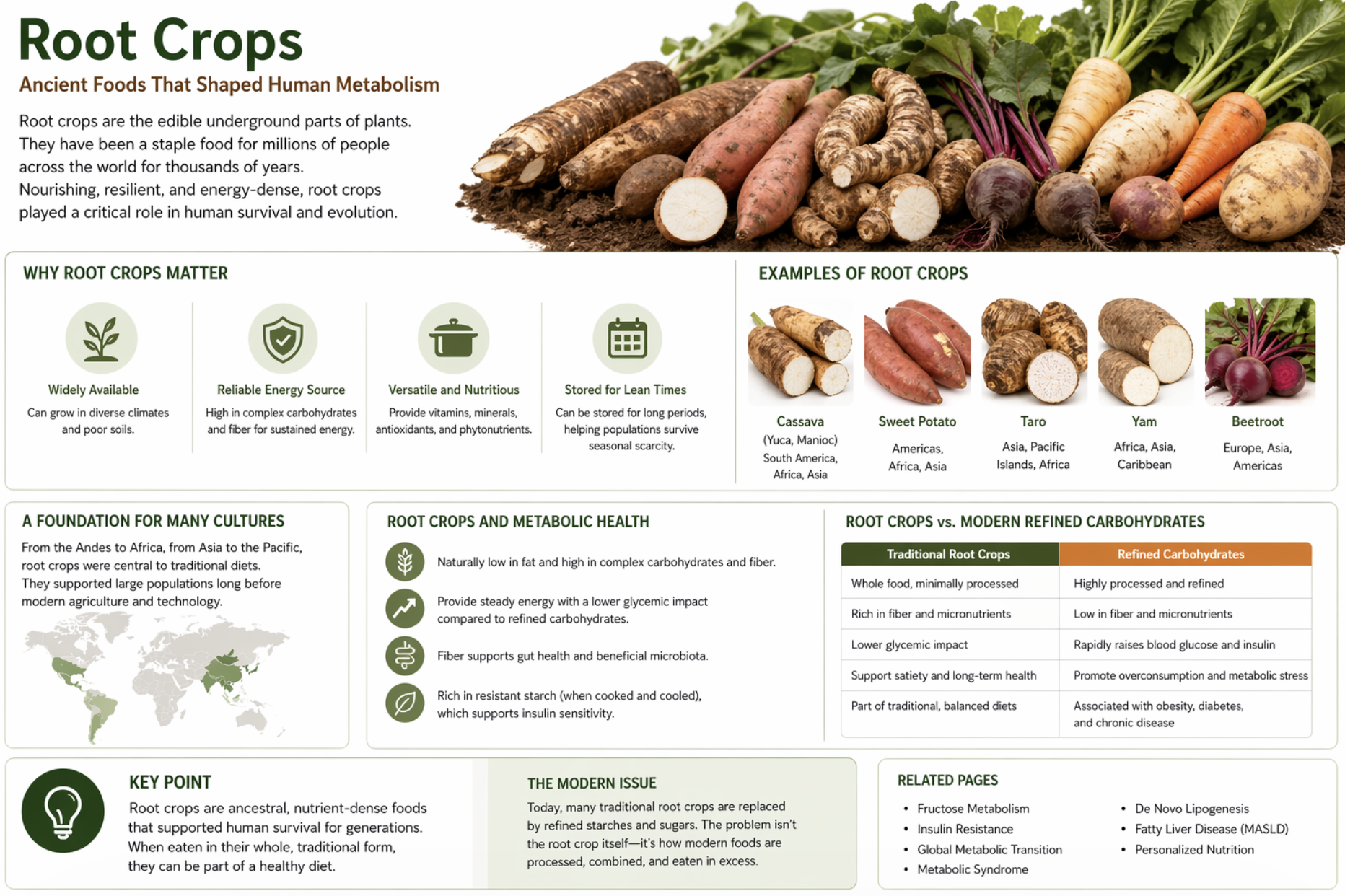
Traditional Starches With Deep Global Roots
Ancient foods with broad human compatibility
Root crops have sustained human populations for millennia.
Across the Pacific, Africa, Asia, the Americas, and parts of Europe, traditional diets often depended on locally adapted starches such as:
- taro
- yam
- cassava
- sweet potato
- potato
- ube
- breadfruit
These foods were not luxury items. They were staples.
They provided reliable energy in environments that differed greatly in climate, geography, and culture. From Andean highlands to Pacific islands, root and tuber crops helped support stable food systems long before the rise of refined flour, packaged foods, and industrial sweeteners.
What root crops have in common
Although these foods come from different botanical families and regions, they share several important features.
In their traditional form, root crops are generally:
- rich in starch
- relatively high in potassium
- higher in fiber than refined flour products
- low in added sugar
- low in fructose
This matters metabolically.
They provide carbohydrate in a form that is usually slower and more structured than the refined starches found in white bread, snack foods, and many modern processed products.
Root crops are not all identical
Root crops are not interchangeable, and preparation matters.
Boiled or steamed preparations are generally more metabolically stable than:
- frying
- heavy sweetening
- industrial processing
- conversion into refined flour products with added sugars and fats
Traditional preparation methods preserve food structure. Modern processing often strips it away.
That distinction is more important than the crop alone.
Examples of important root crops
Taro
Taro is one of the most important traditional starches across the Pacific and parts of Asia.
It is notable for:
- a relatively gentle glycemic effect when boiled
- fiber and mucilage that slow absorption
- strong cultural importance in many island food systems
Taro is one of the clearest examples of a traditional staple that differs metabolically from refined white flour products.
Yam
Yams have sustained populations across Africa, the Caribbean, and Asia.
They provide:
- dense starch energy
- fiber
- potassium
In traditional meal patterns, yam functions as a stable starch rather than a rapidly absorbed processed carbohydrate.
Cassava
Cassava is a major staple across Africa and parts of Latin America.
It is an important survival crop because it:
- grows in difficult environments
- stores well
- provides reliable energy
Like other root crops, its metabolic effect depends heavily on preparation. Whole-food preparations are very different from processed starch products made from cassava.
Potato
Potatoes are one of the most globally widespread staple foods.
In their whole, boiled form, potatoes can function as a structured starch food. Problems arise when they are transformed into:
- fries
- chips
- heavily processed starch products
The issue is often not the potato itself, but the way modern food systems process and market it.
Ube
Ube, the purple yam familiar in the Philippines and increasingly elsewhere, is another traditional starch with deep cultural roots.
In traditional forms, ube is very different from modern sweetened purple desserts or highly processed bakery products. The food itself and the industrial version are not metabolically equivalent.
Breadfruit
Breadfruit has been a major staple in Pacific food systems.
It represents an important example of a traditional starch that supported stable island diets before imported flour products and sugary beverages became dominant.
Root crops versus refined carbohydrates
This is the central comparison.
Traditional root crops are typically:
- whole or minimally processed
- eaten as part of meals
- paired with fish, legumes, vegetables, or other whole foods
- lower in sugar exposure than many modern convenience foods
Refined carbohydrates, by contrast, are often:
- stripped of fiber
- rapidly absorbed
- eaten frequently
- combined with sugar, seed oils, and processed ingredients
This means the metabolic problem is not “carbohydrate” in the abstract.
It is the shift from structured traditional starches to refined, rapidly delivered carbohydrates.
A globally shared pattern
One of the most interesting features of root crops is how widely they have supported different populations.
These foods appear in:
- Pacific island diets
- African food systems
- Andean and Latin American patterns
- Asian agricultural traditions
That does not mean every root crop is identical, but it does suggest something important:
👉 traditional starches have been broadly compatible with human metabolic health across very different ethnic and geographic settings.
Why preparation matters
A boiled root crop is not the same as a fried snack.
A traditional taro meal is not the same as a sweetened taro pastry.
A potato is not the same as a bag of chips.
Preparation changes:
- absorption speed
- fiber effect
- satiety
- total energy density
- metabolic impact
This is why traditional food systems matter. They preserve not just ingredients, but structure.
Root crops and metabolic health
In the context of modern metabolic disease, root crops are often safer than refined flour products when they are eaten in traditional form.
They may help by:
- reducing rapid glucose exposure
- lowering dependence on refined grains
- restoring structured starch intake
- improving satiety compared with processed foods
They are not magical foods, and they can still be overprocessed or overeaten.
But compared with white flour products, sugary baked goods, and packaged starches, traditional root crops often represent a return to a more metabolically stable pattern.
The real modern issue
The problem is not that humans eat starch.
The problem is that modern diets have replaced traditional starches with:
- refined wheat flour
- industrial baked products
- fried starches
- sugar-rich processed foods
In many regions, this replacement happened quickly.
The result was not simply dietary change, but a change in the speed, frequency, and intensity of metabolic exposure.
Bottom line
Root crops are among the oldest and most globally important staple foods in human history.
When eaten in traditional, minimally processed forms, they provide:
- structured carbohydrate
- fiber
- potassium
- cultural continuity
- more stable metabolic pacing than many refined modern starches
The key distinction is not “starch versus no starch.”
It is:
👉 traditional root crops versus refined industrial carbohydrates
Related pages
Safe Starches
Bread
Rice
Sugary Drinks
The Modern Diet
Global Metabolic Transition