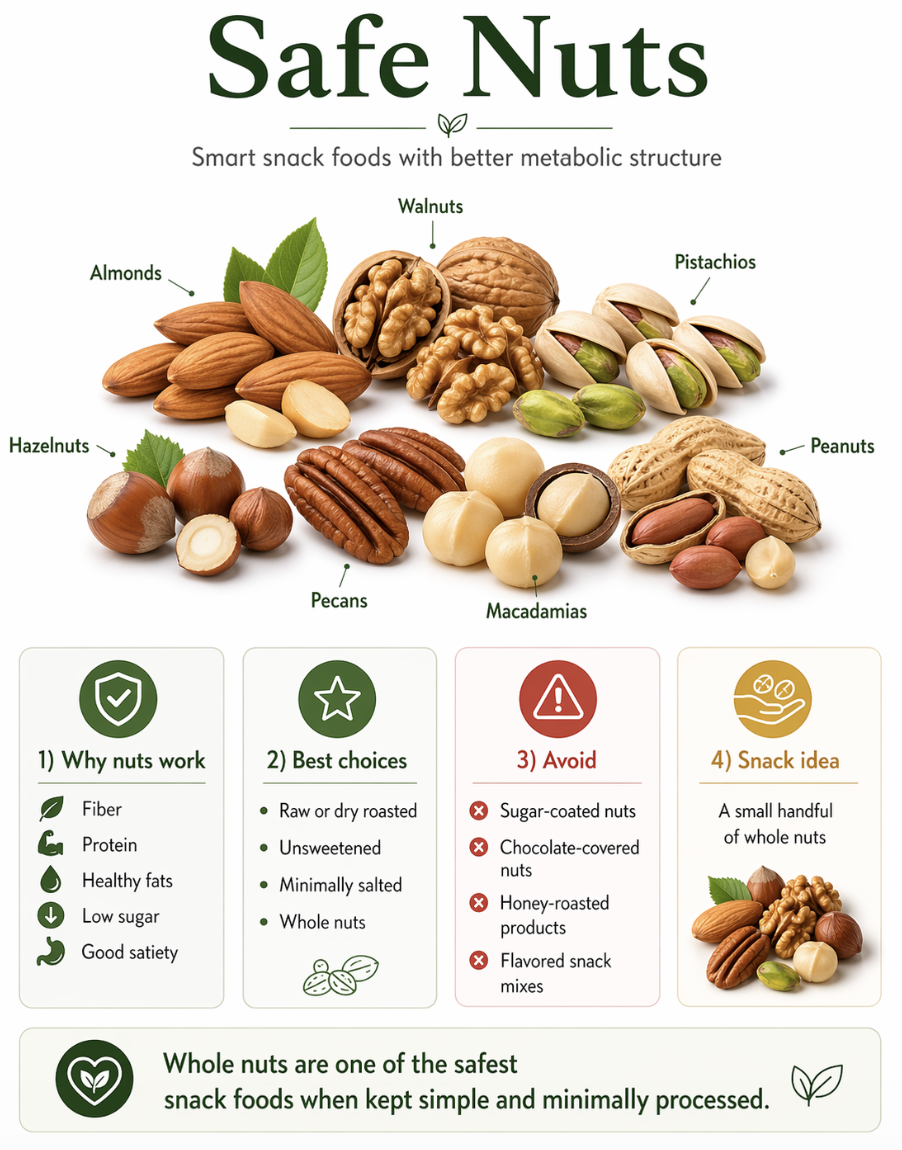
In the modern food environment, many snacks are built from refined flour, added sugar, industrial oils, and salt.
Nuts are different.
Across many traditional diets, nuts have served as:
- portable foods
- seasonal foods
- dense energy sources
- minimally processed snacks
When eaten in simple, whole forms, nuts can be one of the safest modern snack choices.
What makes nuts different?
Whole nuts combine several useful metabolic features in one food:
- natural fat
- fiber
- protein
- minerals
- low sugar content
This gives them a very different metabolic profile from:
- crackers
- cookies
- chips
- sweetened snack bars
- refined baked snacks
Nuts are energy-dense, but they are also structurally intact and slow to eat.
That matters.
Why nuts work as snacks
A good snack should do three things:
- reduce hunger
- avoid rapid glucose spikes
- avoid creating a second cycle of craving
Whole nuts often do this better than processed snack foods because they are:
- low in rapidly absorbed carbohydrate
- rich in fat and protein
- naturally filling
They slow eating rather than encourage fast overconsumption.
Safer choices
The safest nut snacks are usually the simplest ones.
Good options include:
- almonds
- walnuts
- pistachios
- hazelnuts
- pecans
- macadamias
- peanuts in minimally processed form
These are best when they are:
- dry roasted or raw
- unsweetened
- minimally salted or unsalted
- not coated in flour, sugar, chocolate, or syrup
The closer the nut is to its original form, the safer it usually is.
Nuts are not candy
Many commercial “nut snacks” are not really nuts anymore.
Problems arise when nuts are turned into:
- honey-roasted products
- sugar-coated snack mixes
- chocolate-covered nuts
- heavily flavored products with starch coatings
- sweetened nut bars
In those forms, the nut becomes a carrier for added sugar and refined ingredients.
That changes the metabolic effect completely.
Nuts and satiety
One of the key advantages of nuts is satiety.
Because they contain fat, fiber, and protein, they tend to:
- reduce hunger
- slow eating
- reduce the urge for repeated snacking
This makes them very different from snack foods built from refined starch and sugar, which are often easy to eat quickly and in large amounts.
Nuts and blood sugar
Whole nuts generally have a low glycemic effect.
They do not behave like:
- white bread
- sweetened cereals
- crackers
- snack cakes
Instead, they help stabilize snack intake by reducing rapid glucose and insulin swings.
This can be useful in a food environment dominated by fast carbohydrate exposure.
A traditional food in many cultures
Nuts appear in many long-standing food traditions.
Examples include:
- almonds and pistachios in Mediterranean and Middle Eastern diets
- walnuts and hazelnuts in Europe
- peanuts in Africa, Asia, and the Americas
- macadamias in Oceania
This broad use across cultures suggests that nuts have long functioned as metabolically stable foods when eaten in traditional forms.
Portion and context still matter
Nuts are not unlimited foods.
They are dense in energy, and modern habits can still turn them into passive overeating.
The safest use is:
- small portions
- simple whole forms
- eaten as part of a structured day
- not paired with sugary drinks or desserts
A handful of nuts is very different from a giant bag eaten mindlessly in front of a screen.
Nut butters are not always the same
Nut butters can be useful, but they require more caution.
The safest versions are:
- made from nuts only
- with little or no added salt
- no added sugar
- no industrial seed oils
Many commercial nut spreads contain:
- sugar
- palm oil or other added fats
- stabilizers
- sweeteners
These products behave differently from plain whole nuts.
Nuts versus processed snack foods
This is the key comparison.
Whole nuts are generally:
- slower to eat
- lower in sugar
- more filling
- less disruptive to glucose control
Processed snacks are often:
- rapidly absorbed
- low in fiber
- easy to overconsume
- designed to encourage repeated eating
The difference is not just calories. It is food structure and metabolic pacing.
Which nuts are especially useful?
Different nuts have slightly different nutrient profiles, but the broad pattern is similar.
Almonds
Widely available, filling, and easy to use as a simple snack.
Walnuts
Rich in unsaturated fats and often useful in meal-based or snack-based eating.
Pistachios
Slower to eat, especially in-shell, which may help with portion control.
Macadamias
Very low in carbohydrate and especially relevant in Pacific and Oceania contexts.
Peanuts
Technically legumes, but often used like nuts. In simple roasted forms, they can still function as a safe snack option.
The real modern issue
The problem is not snacking itself in every case.
The problem is that modern snack culture is dominated by foods that are:
- refined
- sweetened
- salted
- rapidly absorbed
- easy to consume continuously
Whole nuts are one of the few snack categories that can still preserve some of the structure of real food.
Bottom line
Safe nuts are among the best modern snack choices when eaten in simple, whole forms.
They provide:
- fat
- fiber
- protein
- satiety
- low sugar exposure
The key distinction is:
👉 whole nuts versus engineered snack foods
Related pages
Legumes
Root Crops
Bread
Rice
Safe Starches
The Modern Diet
Global Metabolic Transition