Introduction
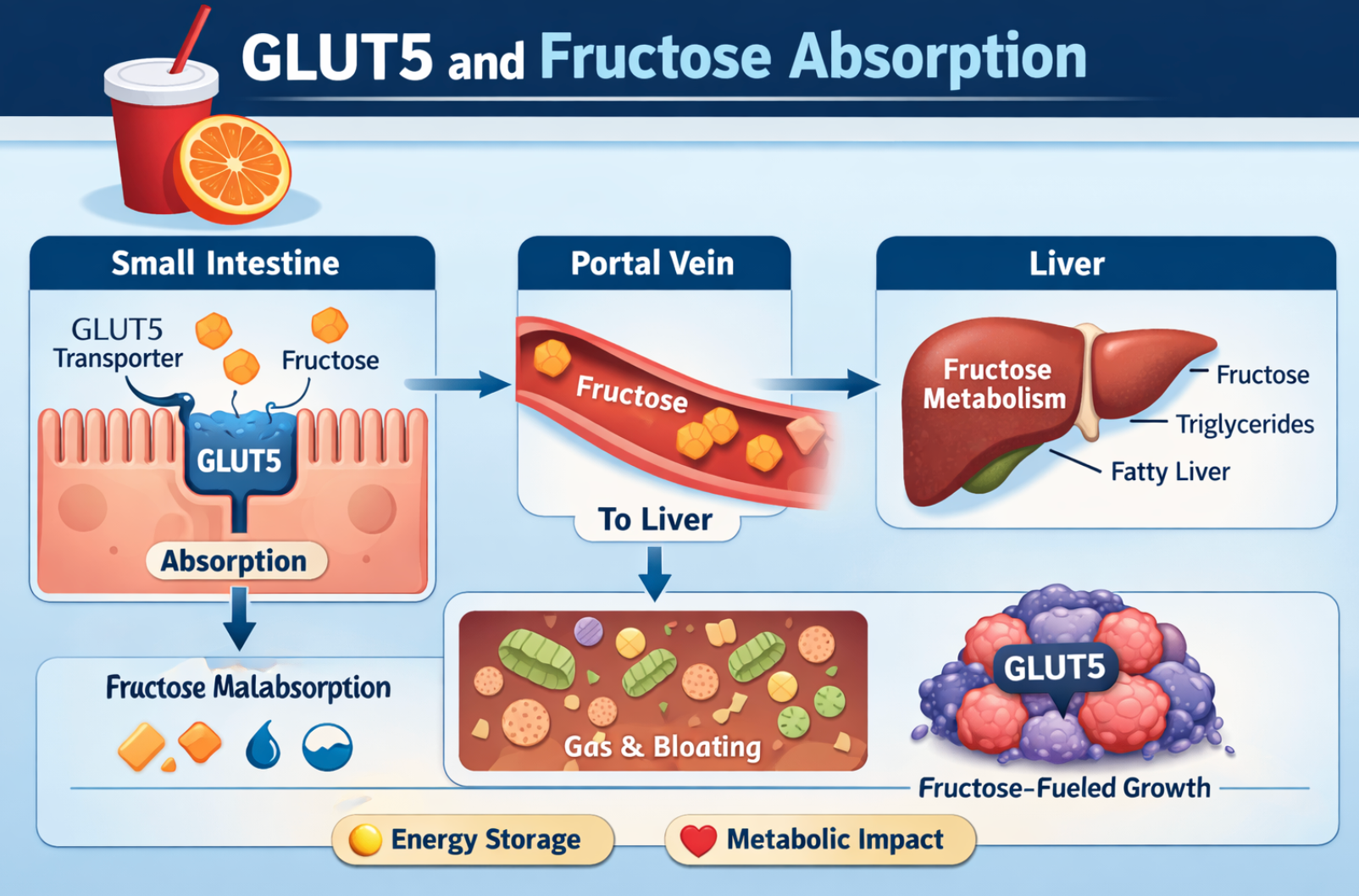
GLUT5 is a specialized transport protein responsible for the absorption of fructose in the small intestine. It plays a central role in determining how dietary fructose enters the body and reaches the liver.
Unlike glucose, which is transported by multiple systems and used widely throughout the body, fructose relies heavily on GLUT5 for its initial uptake. This distinction is one reason why <a href="/fructose-science/fructose-metabolism">fructose metabolism</a> follows a different physiological pathway from other carbohydrates.
Understanding GLUT5 helps clarify how modern diets—often high in added sugars—can influence metabolic health from the earliest stages of nutrient absorption.
What Is GLUT5?
GLUT5 is a member of the glucose transporter family, encoded by the SLC2A5 gene. Despite belonging to this family, GLUT5 is highly specific for fructose and does not significantly transport glucose.
It is located primarily on the surface of intestinal epithelial cells (enterocytes), where it facilitates the movement of fructose from the intestinal lumen into the cell.
After entering the enterocyte, fructose exits into the bloodstream and travels through the <a href="/metabolic-disease/portal-vein-liver">portal circulation</a> to the liver.
Location and Function
GLUT5 is most abundantly expressed in the small intestine, particularly in the jejunum, where nutrient absorption is most active.
Its primary functions include:
- transporting fructose across the intestinal lining
- regulating the rate of fructose absorption
- influencing how much fructose reaches the liver after a meal
Because GLUT5 activity determines how quickly fructose enters circulation, it represents an important control point in fructose metabolism.
Regulation of GLUT5
GLUT5 expression is influenced by dietary patterns.
When fructose intake increases, the body may respond by:
- increasing GLUT5 expression in the intestine
- enhancing the capacity to absorb fructose
- accelerating delivery of fructose to the liver
This adaptive response may have been beneficial in ancestral environments where fructose exposure was seasonal. In modern diets, however, where fructose intake is frequent and sustained, this upregulation may contribute to increased metabolic load on the liver.
GLUT5 and Fructose Malabsorption
In some individuals, GLUT5 activity is limited or overwhelmed, leading to incomplete absorption of fructose.
When this occurs:
- unabsorbed fructose remains in the intestine
- gut bacteria ferment the fructose
- symptoms such as bloating, gas, and discomfort may develop
This condition is sometimes referred to as fructose malabsorption.
The threshold at which this occurs varies widely between individuals and may depend on overall diet, gut microbiome composition, and transporter expression.
GLUT5 and the Liver
Because GLUT5 determines how much fructose is absorbed, it indirectly influences hepatic metabolism.
After absorption:
- fructose travels through the <a href="/metabolic-disease/portal-vein-liver">portal vein</a>
- the liver is exposed to relatively high concentrations
- hepatic pathways process fructose rapidly
This sequence helps explain why fructose metabolism is closely linked to:
- lipid synthesis
- triglyceride production (<a href="/fructose-science/fructose-triglycerides">see pathway</a>)
- <a href="/metabolic-disease/fatty-liver">fatty liver disease</a>
GLUT5 therefore represents the entry point into a metabolic pathway that is largely hepatic.
GLUT5 and Cellular Metabolism
Although GLUT5 is primarily discussed in the context of intestinal fructose absorption, it is also expressed in other tissues, including certain tumor cells.
Some studies have observed that cancer cells may increase expression of fructose transporters such as GLUT5, allowing them to utilize fructose as an additional metabolic substrate. In environments where glucose metabolism is already altered, access to alternative fuels may support cellular growth and survival.
This observation connects to a broader concept in cancer biology known as the <a href="/fructose-science/warburg-effect">Warburg effect</a>, in which cells shift toward glycolytic and alternative metabolic pathways even in the presence of oxygen.
While the role of fructose in cancer metabolism remains an area of active research, these findings suggest that nutrient transport systems such as GLUT5 may influence how cells respond to different metabolic environments.
Evolutionary Perspective
From an evolutionary standpoint, GLUT5 may have supported efficient energy storage.
In environments where fruit was available intermittently:
- rapid fructose absorption could promote fat storage
- stored energy could be used during periods of scarcity
In modern food environments, where fructose is widely available in processed foods and beverages, this same mechanism may operate continuously rather than seasonally.
This shift illustrates the broader concept of <a href="/fructose-science/fructose-evolution-thrifty-pathway">evolutionary mismatch</a> in metabolic disease.
Clinical Relevance
GLUT5 itself is not typically measured in clinical practice, but its function is reflected in downstream metabolic effects.
High fructose exposure—facilitated by efficient absorption—may contribute to:
- elevated triglycerides
- fatty liver disease
- insulin resistance
- metabolic syndrome
For clinicians, understanding GLUT5 helps explain why fructose metabolism is often discussed in relation to liver health and cardiometabolic risk.
Summary
GLUT5 is the primary transporter responsible for fructose absorption in the small intestine. By regulating how fructose enters the body, it plays a key role in determining the metabolic impact of dietary sugars.
Because absorbed fructose is delivered directly to the liver, GLUT5 represents the first step in a metabolic pathway that influences lipid metabolism, energy storage, and metabolic disease.
Understanding this transporter provides important insight into how modern dietary patterns interact with human physiology.