Why Fructose Is Different From Glucose: The Liver, Energy Overload, and Metabolic Risk
The Question That Changes Everything
At first glance, fructose and glucose look similar. Both are simple sugars. Both provide calories. Both are found in foods we eat every day.
But biologically, they are handled very differently.
Understanding that difference is the key to understanding modern metabolic disease.
Two Sugars, Two Pathways
Glucose: A Distributed Fuel
Glucose is the body’s primary energy source. It is used by:
- muscle
- brain
- red blood cells
- virtually every tissue
Its metabolism is tightly regulated:
- insulin controls uptake
- cellular demand influences utilization
- excess is stored in controlled pathways
Glucose is a shared fuel.
Fructose: A Liver-First Load
Fructose follows a completely different route.
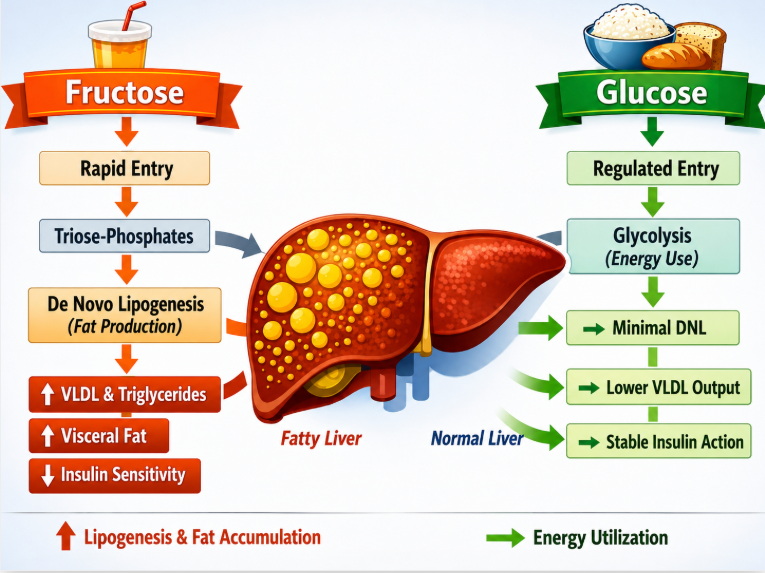
After absorption in the intestine via GLUT5, fructose is delivered almost entirely to the liver.
There is no widespread tissue buffering.
The liver must handle most of it.
The Critical Difference: Regulation
Glucose metabolism is tightly controlled at multiple steps.
Fructose metabolism is not.
In the liver, fructose is rapidly phosphorylated by Ketohexokinase.
This step:
- bypasses key regulatory checkpoints (such as phosphofructokinase)
- proceeds rapidly regardless of energy status
- drives substrate into downstream pathways without restraint
In practical terms, this means:
Glucose is regulated.
Fructose is largely unregulated.
What Happens in the Liver
When fructose intake is low, this pathway is manageable.
When intake is high and chronic, several things happen:
1. ATP Depletion
Rapid phosphorylation consumes cellular energy.
2. Uric Acid Production
ATP breakdown increases uric acid generation.
3. De Novo Lipogenesis
Excess substrate is converted into fat within the liver.
4. Fat Export and Storage
Triglycerides accumulate or are exported into circulation.
The Result: A Predictable Cascade
Over time, repeated fructose exposure leads to:
- Liver fat accumulation
- Insulin resistance
- Elevated triglycerides
- Increased uric acid
- Progression toward Metabolic dysfunction–associated steatotic liver disease
This is not an abstract pathway. It is clinically observable.
Why This Matters in the Modern World
In ancestral environments, fructose exposure was:
- seasonal
- relatively low
- buffered by whole foods
Today, fructose is:
- abundant
- concentrated
- consumed daily in beverages and processed foods
The pathway has not changed. The exposure has.
A Practical Analogy
Think of glucose as a fuel distributed across a network of roads.
Think of fructose as traffic forced through a single narrow gate—the liver.
When traffic is light, the system works.
When traffic is constant and heavy, the gate becomes congested, and the system breaks down.
Clinical Implications
For clinicians, this difference explains why:
- Fatty liver can develop even when total calories are not extreme
- Triglycerides rise disproportionately
- Uric acid increases early
- Insulin resistance emerges before overt diabetes
It also explains why:
- normal liver enzymes do not exclude disease
- imaging findings should not be ignored
- early intervention matters
Where This Connects
To understand the full pathway, see
Bottom Line
Fructose and glucose are not metabolically equivalent.
Glucose is a regulated, widely distributed energy source.
Fructose is a liver-centered, minimally regulated substrate that—when consumed in excess—drives fat production, metabolic dysfunction, and disease.
That difference is at the core of the modern metabolic crisis.